Lenin participates in affiliate programs. Using links helps fund archiving and scanning work.
Born in New York City, Adolph Gottlieb was a pioneering American artist who studied not only in his hometown but also abroad in Paris, Berlin, and Munich. Early in his career, he worked in an expressive, Expressionist style, completing commissions for the Federal Art Project in 1936. His work at this stage already hinted at his fascination with emotion, symbolism, and the psychological depth of imagery.
Gottlieb maintained a lifelong friendship and artistic dialogue with Mark Rothko, and together they helped shape Abstract Expressionism in the United States. Through experimentation with automatic painting, he sought to access mythic narratives, subconscious realms, and deeply personal archetypes. This exploration of the mind became a hallmark of his style, bridging raw emotion with symbolic abstraction.
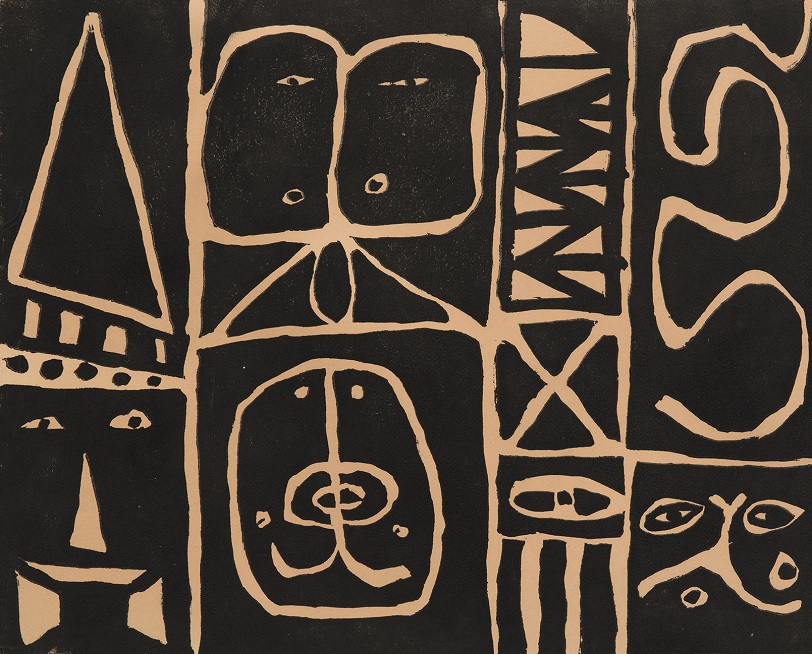
During the 1950s, Gottlieb developed his distinctive series of pictographs, evolving over time from chequerboard panels into broad bands containing symbolic imagery drawn from Native American motifs — hands, eyes, snakes, and arrows. By 1956, these symbols gave way to cosmic explorations: expansive discs of color set against explosive black forms, evoking both order and chaos, and reflecting his fascination with universal forces and the mysteries of the human psyche.
Beyond the canvas, Gottlieb extended his vision into monumental works, including a massive stained-glass facade for the Steinberg Memorial Center in New York (1952). His contributions to mid-20th-century American art continue to be celebrated for their intensity, innovation, and the unique way they capture the intersection of emotion, symbol, and abstraction.
In the years leading up to his death in 1974, Gottlieb continued to paint and experiment, though his output slowed somewhat as he faced the natural challenges of aging. He remained deeply engaged with the themes that had defined his career — the interplay of emotion, myth, and abstraction — and maintained his role as an influential figure in the Abstract Expressionist movement. His final works reflect a quieter, more reflective intensity, demonstrating a lifetime spent exploring the subconscious and the symbolic language of art. Gottlieb passed away in New York, leaving behind a legacy of innovation, profound psychological depth, and a body of work that continues to inspire and captivate artists and collectors alike.
Lenin participates in affiliate programs. Using links helps fund archiving and scanning work.