Lenin participates in affiliate programs. Using links helps fund archiving and scanning work.
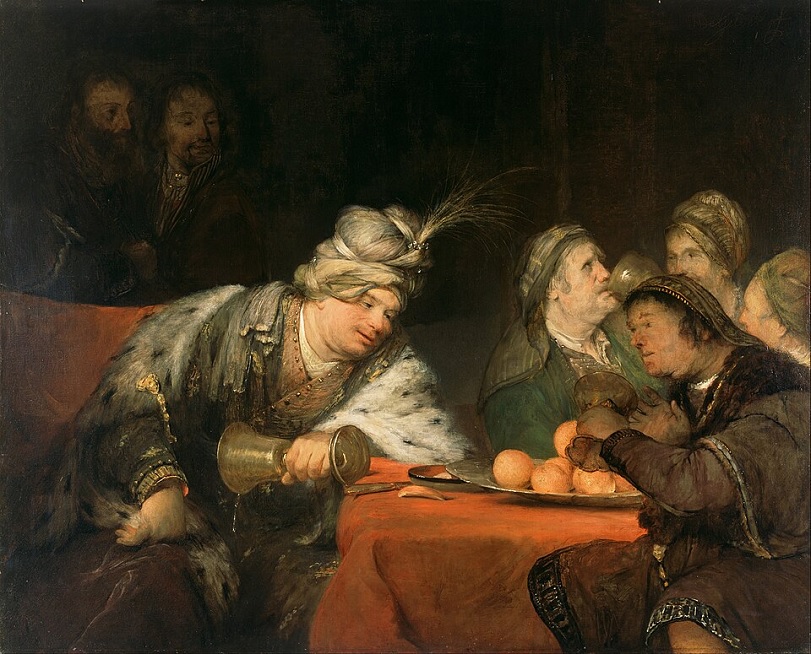
Aert de Gelder, one of the last and most devoted pupils of Rembrandt, entered his studio in the 1660s and absorbed his master’s dramatic style more completely than any other follower. What sets de Gelder apart, however, is the way he carried Rembrandt’s late manner well into the 18th century, subtly reshaping it with touches of Rococo influence. By lightening the traditionally deep Rembrandtesque palette and weaving in pinks, violets, and brighter tonal accents, he created a personal interpretation of his teacher’s aesthetic without sacrificing its emotional weight.
His principal subjects were biblical narratives and portraiture, and many of his Old Testament scenes are unmistakably rooted in the Rembrandt tradition — from the warm, glowing layers of colour to the expressive, “Orientalised” costumes and dramatic use of light. One of his finest works, Jacob’s Ladder (Dulwich), was so convincingly executed in Rembrandt’s manner that for much of the 19th century it was celebrated as an undisputed Rembrandt masterpiece. De Gelder may also have played an important historical role by supplying early biographical information about his teacher to Rembrandt’s first biographer.
A significant group of his New Testament scenes, dating to around 1715, is housed in the galleries of Aschaffenburg and Munich. His work can also be found in a remarkably wide range of international collections, demonstrating the reach and appreciation of his art in modern times. Examples appear in Amsterdam, Berlin, Birmingham (Barber Institute), Boston, Brighton, Cambridge (Fitzwilliam), Chicago, Dordrecht, Dresden, Frankfurt, The Hague, Melbourne, Paris (Louvre), Providence (Rhode Island), Rotterdam, Vaduz (Liechtenstein Collection), and Vienna. These surviving pieces reveal a painter who honoured Rembrandt while confidently forging a style distinctly his own.
Lenin participates in affiliate programs. Using links helps fund archiving and scanning work.