1977 Sci-fi drama
When You Wish Upon a Star by LeighHarline, Ned Washington The Square Song by Joseph Raposo Love Song of the Waterfall by Bob Nolan, Bernard Barnes, Carl Winge, sung by Slim Whitmancast
crewPhillips / Columbia / EMI
Julia Phillips, Michael Phillips
Clark Paylow
Steven Spielberg
(Metrocolor, Panavision): Vilmos Zsigmond, William A. Fraker, Douglas Slocombe
Robert M McMillian
John Alonzo, Laszlo Kovacs, Steve Poster
Richard Yuricich, Dave Stewart, Robert Hall, Don Jarel, DennisMuren
Robert Swarthe
Harry Moreau, Carol Boardman,Eleanor Dahlen, Cy Didjurgis, Tom Koester, Bill Millar, Connie Morgan
Steven Spielberg
Douglas Trumbull
Larry Robinson
Mona Thal Senefiel
Robert Shepherd
'Fast' Eddie Mahler
Michael Kahn
Dan Lomino
Joe Alves, Phil Abramson,Matthew Yuricich, George Jensen, Carlo Rambaldi
Roy Arbogast, George Polkinghorne
Dom Trumbull, John Russell, Fries Engineering
Jerry L, Jeffress, Alvah J. Miller, Peter Regla, Dan Slater
Gregory Jein, J. Richard Dow, Jor Van Kline, Michael McMillen, Kenneth Swenson, Robert Worthington
John Williams
Chances Are by Al Stillman, RobertAllen, sung by Johnny Mathis
Jim Linn
Bob Westmoreland
Dan Perri
Gene Cantmessa, Buzz Knudson, Don MacDougall, RobertGlass
Steve Katz
Frank Warner, Richard Oswald, David Horton, Sam Gemette, Gary S. Gerlich, Chet Slomka, Neil Burrow
Dr. J. Allen Hynek
Peter Anderson, LarryAlbright, Richard Bennett, Ken Ebert, Paul Huston, David M. Jones, KevinKelly, Jim Lutes, George Randle, Jeff Shapiro, Rourke Engineering
Colin Cantwell
Buddy Joe Hooker
Chuck Myers, Jim Bloom
(Columbia)

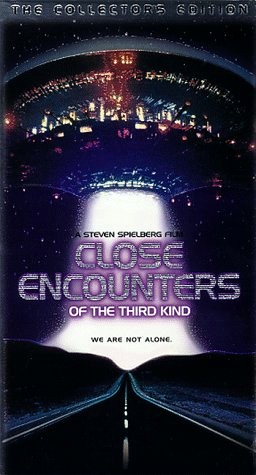
- [ c l o s e e n c o u n t e r s : m o v i e r e v i e w ]
- 1977: Best cinematography; Special Achievement Award (sound effects editing)
- Nominations: Best director; Best Supporting Actress (Melinda Dillon); Art Direction; Editing; Original Score; Sound; Special Visual Effects
- Advertise Here


Rated: 
- Riding high on the success of Jaws(1975), Steven Spielberg began hisambitious project- initially entitled Watch the Skies - with full studiobacking. He constructed an enormous set in an airplane hangar inMobile, Alabama, while shootingcertain outdoor scenes in a sectionof Indiana desert land reminiscentof Jack Arnold's locations in ItCame From Outer Space (1953) and Tarantula (1955). Over a year wasspent shooting and re-shootingscenes on various other international locations with the help ofsome top cinematographers. Thesesequences jigsawed together fortwo versions, the first demanded byan impatient Columbia, released in1977, and the second - Spielberg'sauthorized version - released threeyears later.
Although the Special Edition (1980) contains additional scenes,the overall effect of the two films isthe same. Both are wonderful, brilliantly constructed science-fictiondrama featuring complex specialeffects which are enhanced by Spielberg's single-minded, all-American, all-Hollywood vision. Itis a mammoth spectacle, as gripping as Hitchcock, as magical as Disney's early animated features,and as humanely optimistic as thebest of the Sixties television series The Outer Limits (1963-65). The story is presented from threesimultaneous viewpoints; that ofthe innocent child and his distraught mother, of an intriguedelectrical engineer, and of a groupof scientists led by Francois Truffaut playing in his first American movie. Everything revolves aroundfive or six breathtaking set-pieces;the narrative intercuts betweenthese 'close encounters', excitinglyrevealing the clues which lead tothe moving climax when the extra-terrestrials come to rest on Devil'sTower. Superbly edited throughout, the film moves at an extraordinarypace, teasing the audience withconstant references to the otherbeings as Lacombe and his UFOinvestigators discover the secret ofthe five musical tones - a signalcontinuously broadcast from outerspace. In the first sighting is encapsulated all the success of Close Encounters of the Third Kind: aroundthe curve of the road come threemulticoloured, gyrating shapes atincredible speed but slow enoughto be in full view of witnesses andthe audience. By shooting the special effects in 70mm and the rest in35mm, which is then blown up to70mm, the quality of the print isconsistent so that the spacecraftlook completely real. It is the immaculate special effects, integrated so perfectly with the heart-stopping narrative, which are thetrue stars of Close Encounters. Thefinal sequence - the arrival of the mothership on Devil's Tower - is asstartling as Cecil B. DeMille's parting of the waves inf The Ten Commandments (1956). Anyone would find it difficult not to believe that thisgreat citadel in the sky, twice as high as the mountain, really exists. Unlike the swashbuckling heroics of that other high-budget,cosmic adventure movief Star Wars (1977, dir. George Lucas), the effectiveness of Close Encounters lies in our ability to believe thatbeyond the stars superior powers are benevolent and caring. In those closing moments the audience isallowed the kind of emotional participation not felt in cinemas since Judy Garland walked over the rainbow and Dumbo flew: perfect escapism for our troubled times. Lost on the road while trying to In another part of the same Spurred on by newspaper and Jillian's son is invisibly On arrival they find everything An exciting chase culminates in A fleet of dancing, whoosing,p l o t
establish the cause of a massive
power-cut, Roy Neary sees a set
of bright lights approaching.
Instead of passing straight by, the
intense rays rise above his truck,
and immediately there is a loss of
all gravitational force in his cab.
black-out a young boy awakes to
find the entire house in bizarre
confusion; all the electrical
appliances have switched
themselves on. Amused and
amazed, he runs into the night
pursued by his fearful mother,
and mysteriously appears at the
edge of a hill-top road where Roy,
Jillian and the boy witness three
of the alien spacecraft.
television reports, interested
people turn up for these sightings.
Meanwhile, a group of scientists
led by Claude Lacombe has found
evidence in other continents that
a certain musical pattern can be
linked with the aliens' efforts to
communicate.
kidnapped by the extra-terrestrials,
and Roy alienates his own family by
building a clay model of the visions
he has seen of a flat mountain. As
soon as he realizes, along with Jillian,
that the model in his living room
is the Devil's Tower in Wyoming
and that the aliens want them to
be there, he and Jillian race
acrodd country.
cordoned off by Lacombe and the
military who have simulated a
nerve-gas scare. All the
unwelcome humans drawn there
are rounded-up for interrogation,
but Roy and Jillian escape.
the discovery of a colossal
runway, a giant electronic board
covered with coloured stripes, and
a powerful musical keyboard. All
their former paranoia is calmed
by this sight, and their weird
obsessions and premonitions now
become crystal clear.
neon-light spaceships precede the
landing of the huge mothership.
Communication between the
scientists and the craft is initiated
by the playing of the five mystical
notes, and culminates in an extra-
terrestrial duet. Roy eventually
enters the mothership surrounded
by the aliens - their embryonic
features clear and their intentions
obviously harmless. With sadness
Lacombe and his team watch the
friendly visitors leave. From a
vantage point, Jillian and her son
see the craft move off.
OSCARS: