|
Sir David Wilkie
Victorian Painting. Victorian Art Index Corrections
Art Store Advertise Search Site Gallery
David Wilkie - Remarks on Painting (published posthumously in 1843)
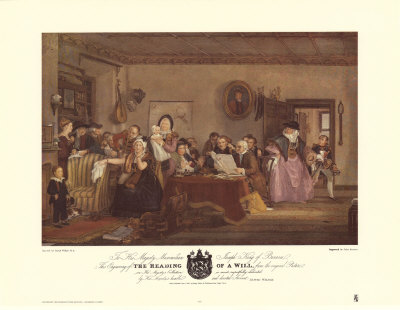
He was the son of a Presbyterian minister, the minister of Cults, Fifeshire, and studied in Edinburgh. As a boy he diligently studied prints after Van Ostrade and Teniers. His first important work, painted when he was 19, was Pitlessie Fair (1804: Edinburgh, NG) which is a remarkably accomplished essay in the manner of Teniers. In 1805 he entered the RA Schools in London and exhibited his Village Politicians in the RA of 1806. This made his name and led to his treating similar subjects in the style of Ostade or Teniers for some twenty years. These 'Dutch' genre scenes had great influence in Germany: he received a commission from the King of Bavaria in 1819 for Reading the Will (Munich). He was elected ARA in 1809, RA in 1811, succeeded Lawrence as Painter to the King in 1830, and was knighted in 1836. He was a friend of Haydon - although he had the sense not to attempt Haydon's High Art - and they went to Paris together in 1814 to see the pictures looted by Napoleon. He was most impressed by Rubens and by Rembrandt, especially in his drawings.
The Prince Regent himself purchased two important works, The Penny Wedding (1819) and Blind Man's Buff. The latter is indebted to Van Ostade in composition and handling, and also to the French narrative tradition.
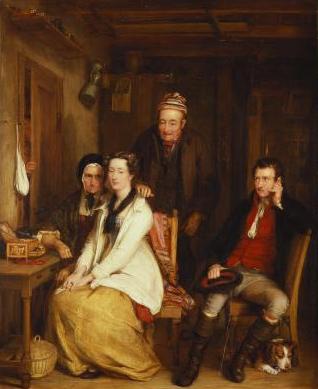
He excelled at small-scale cabinet-sized pictures, The Refusal (1814: London, V&A) being a prime example. This painting was inspired by Robert Burns's poem about the wooing by Duncan Gray of the 'Haughty Hizzie Meg ... deaf as Ailsa Crag'. Wilkie's sister sat as the model for Meg, his friend William Mulready for Duncan Grey and Mulready's parents as Meg's mother and father.
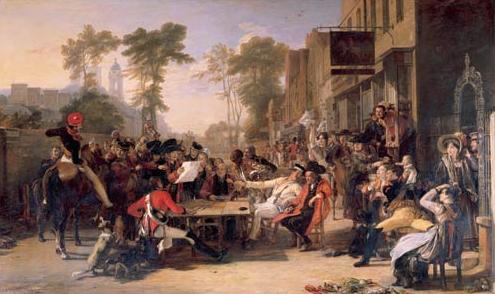
To commemorate the defeat of Napoleon the Duke of Wellington commissioned Wilkie in 1816 to paint Chelsea Pensioners Reading the Gazette of the Battle of Waterloo (1822: London, Wellington Mus.). The Duke had originally suggested a small picture on the theme of 'British Soldiers Regaling at Chelsea', and it was Wilkie's idea to introduce the dramatic event of nthe arrival of the news of the great British victory. Wilkie took immense pains with the crowded scene, constructing a box within which he experimented with small model figures in order to resolve the composition. The work took 5 years to complete, and Wilkie asked the then huge price of 1,200 guineas for it, to the chagrin of the Duke, who insisted on paying in bank notes rather than by cheque, in order that the clerk at his bank, Coutts, should not think him 'a damn fool for paying so much for a picture'.
When the painting was shown at the Royal Academy in 1822 it was an immense success: high and low flocked to see it, enraptured by its patriotic subject. So great were the crowds that for the first time in the history of the Academy, a barrier had to be erected in order to protect the work.
Because of ill-health he spent 1825-8 in Italy, Austria, Germany and Spain, and his new experience of Italian and Spanish art led to a great style change; Velazquez and Murillo being the principal influences on the new broader manner and change of subject-matter, which included several histories. He showed some drawings to Delacroix in Paris in 1825, who noted that Wilkie was 'unsettled by the paintings he had seen'. and he seems to have been the first British artist to see the Spanish masterpieces in the Prado. His style change was not universally approved, and even Haydon said that Italy had been the ruin of him.
In 1840 he went to the Holy Land and died at sea on the way home from a fever contracted while researching material for biblical paintings: his burial at sea is the subject of an imaginative composition by Turner.
There are examples in the Royal Coll. and in Aberdeen, Berlin, Birmingham, Cupar Fife (Town Hall), Dublin, Edinburgh (NG, NPG, United Services Mus.), Leicester, London (Tate, Wallace Coll.), New York (Met. Mus.), Riga, Toledo Ohio and Yale (CBA).
--------------------------------------
CORRECTIONS: (MARCH 2013). THANKS TO GERDA.
Father correct - Reverend David Wilkie of Cults Kirk, Cupar, Fife, Scotland
Mother was 2nd wife: Isabella Lister - date of marriage not known
1st wife was Mary Campbell sister of another Reverend - George Campbell in Cupar, Fife, Scotland
Married 18 Oct 1776, Mary died 8 Feb 1777 of consumption and fever
--------------------------------------
8 DAVID WILKIE, THE PAINTER
(that's Rev. Dr George Campbell)
'"1776. October 18. — Was this day married to one of the most beautiful women in Fife, Miss Mary Campbell, sister to George Campbell, one of the ministers of Cupar." This young lady was the aunt of the present Lord Campbell, and is still remembered as one of the loveliest women of the land. These sad words follow : — " 1777. February 8. This day my beloved wife departed this life, having been taken ill of a fever attended by consumption — an event the most afflicting I ever met with."
Thus began, but did not end, the friendship between the families of Wilkie and Campbell.'— Editor.
Consumption is believed to be tuberculosis
Editor of the book of Life of Lord Campbell
--------------------------------------
CHAP. 174, LIFE OF LORD CAMPBELL. A.D. 1805.
John CAMPBELL 15 Sep 1779 at house next to the Bell Inn, Eden Road, Edinburgh resigned with
Lord
Melbourne's Government in August 1841;
3 November 1800 Entered Lincoln's Inn, London (Study of Law) address: 2 Old Buildings, Lincoln's Inn, London, Middlesex, England;
circa 1847 Lord High Chancellor of Great Britain
died 24 Jun 1861 most probably somewhere in London, England
--------------------
LIFE OF JOHN, LORD CAMPBELL - LORD HIGH CHANCELLOR OF GREAT
printed John Murray, Albermarle Street, London, Middlesex, England
archive.org/stream/cu31924021673565/cu31924021673565_djvu.txt
Sir John CAMPBELL writes:
'I called this morning after breakfast upon David Wilkie.
When he first put the portrait* into my hand I was disappointed, but afterwards, when I placed it upon the mantelpiece and looked at it from a distance, it struck me as one of the best likenesses I had ever seen.
If I were sure it would reach Agra safe, I would send it off immediately, but I do not like to expose it to so long a journey, and shall therefore keep it, I think, till George comes home. Wilkie is to get it framed for me.
He absolutely refused taking anything for painting it.
I am sorry for this, but I pressed it upon him as far as I could with propriety.
I was glad to hear from him that the Duke of Gloucester had behaved very liberally to him.
The stipulated sum he was to receive for 'The Card Players' was fifty guineas. His Royal Highness gave him a hundred and fifty. I am rather in pain about 'The Sick Girl and the Physician.' She is a fat, blowsy-looking wench, and he, I fear, has not much character of any sort. But I hope that he will yet improve the piece considerably, or that my opinion of it is quite erroneous. On every account I take the liveliest interest in his prosperity.'
» While the Rev. Dr. Campbell was in London, Wilkie painted a small portrait of him, now in the possession of
Lord Stratheden and Campbell.— Editor.
|
 |
| 
 |
| 
|
|