Books | Dvds | Videos | Second Chorus Top Hat, White Tie and Tails
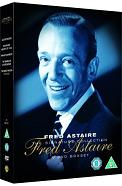
Fred Astaire Collection Fred Astaire was certainly no overnight celebrity. His real name was Frederick Austerlitz and he was born on May 10 1899. At the age of four and a half he was enrolled, along with his six year old sister Adele, in a dance school by his ambitious mother. From then on it was show business every inch of the way. By 1917 Fred and Adele had featured roles in a Broadway musical; five shows later in 1922, they starred in The Bunch and Judy. Four big shows followed - Lady, Be Good! and Funny Face, both written by the Gershwins, Smiles, by Vincent Youmans, and The Band Wagon by Dietz and Schwartz - that brought the pair legendary status. Adele's retirement to get married in 1932 was the first real crisis in Fred's career: the team was great, but how would he make it on his own? The answer , in his next show, Gay Divorce, in which he starred with Clare Luce, proved to be: very nicely, thank you. But he was clearly ready for a real change and offers from Hollywood seemed to provide it. |  Rita Hayworth and Fred Astaire You Were Never Lovelier |
There still remained the problem of a partner. Though Fred usually had a speciality solo of some kind in his shows, the centre had always been the numbers he shared with his sister, who everyone agreed was his perfect complement in height, personality and technique. Someone had to be found for Fred's next film Flying Down to Rio (1933). Back at his own studio, RKO, he was only fifth on the bill below Dolores Del Rio (in very big letters) and (much smaller) Gene Raymond, Raul Roulien and Ginger Rogers. Ginger Rogers was by no means a name to conjure with at this time. She had recently been put under contract by the same studio after singing and dancing in vaudeville and stage musicals. She had provided the romantic interest in a number of small movie comedies, and, on loan to Warner Brothers, had received tolerable reviews for her playing of hard-boiled chorus girls in 42nd Street (1933) and Gold Diggers of 1933 (1933). She was hard-working and resilient, but no-one thought she was a great dancer - or a great anything. But she was available, and thus easy to team with Astaire in a story which mainly concerned Dolores Del Rio trying to choose between the relative merits of Gene Raymond and Raul Roulien. Just as casually as that, one of the great romantic teams of the Thirties cinema came into being. Against all expectation the big success of the film was not its romantic story but these two supporting players performing their one number together. Vincent Youmans' The Carioca. At a time when Hollywood was quick to respond to audience reaction, the flood of letters and comments from ordinary movie-goers meant only one thing: Fred and Ginger must be brought together as soon as possible in a film of their own. The Gay Divorcee (1934), a thorough reworking of Astaire's last stage success soon followed, and then in almost unbroken succession Roberta (1935), Top Hat (1935), Follow the Fleet (1936), Swing Time (1936), Shall We Dance? (1937), Carefree (1938) and The Story of Vernon and Irene Castle (1939). Throughout these years the Astaire/Rogers films were RKO's most reliable box office, performing the same bacon-saving function as the Mae West films did at Paramout and a little later, Deanna Durbin films did at Universal. They also featured some amazing collaborators, especially on the musical side, with scores (often original scores) by Youmans, Cole Porter, Jerome Kern, the Gershwins and Irving Berlin - who in particular did much of his best work for Top Hat, Follow the Fleet and Carefree.
But the point was always Fred and Ginger. Though sentimental fans liked to fantasize real-life romances between their screen favourites - not always inaccurately, as in the case of Jeanette McDonald and Nelson Eddy - Fred and Ginger's was a professional marriage of convenience. Socially they had little to do with each other outside the studio; but they worked perfectly together. It may be that a measure of antagonism is good in such a relationship - certainly many of their most famous romantic numbers show them at first pulling away from each other and then drawing together as if in spite of themselves. Similarly the plots of their films nearly always consisted of variations of the formula: boy meets girl, boy hates girl (and vice versa) - but since they are deeply attracted to each other (hence the superficial hostility) every thing turns out right in the end Someone (supposedly Katherine Hepburn, who was the other big star at RKO at the time) said that the secret of their success was that he gave her class and she gave him sex appeal. Certainly her bright brash exuberance contrasted very well with his elegant understatement and ironic charm. Though he was the creative one behind the scenes - he would spend weeks working out the films' dance routines, rehearsing himself, her and everyone else involved with an inch of their lives to get it all exactly right - she was a quick and eager study, able, when shown how, to be not only a perfect foil for him but a full partner with a positive contribution to make. The films are consequently memorable, not only for his speciality dance solos but also for two similar but distinguishable kinds of dance duet: the straight romantic, and the love-hate kind.
It takes two or three films for the pattern to become perfectly established; in The Gay Divorcee the normal relationship between the partners is not yet clear, though the film does have a romantic number, Night and Day, and a novelty dance to introduce The Continental, in which 'you kiss while dancing'. In Roberta it is nearly there, though the main romantic interest resides in Irene Dunne and Randolph Scott - at least Fred and Ginger have a 'togetherness' dance number to Smoke Gets In Your Eyes and an 'antagonism-rivalry' number in I'll Be Hard to Handle. By Top Hat it is all there: Astaire's showy solo dancing on sand in No Strings, and again in the title number where he 'shoots' a whole chorus of white tied look-alikes; a love hate number in Isn't This a Lovely Day? with the two of them marooned by a freak thunderstorm on a bandstand in a park; and a classic love-love number with them dancing unmistakably Cheek to Cheek. From that point on Astaire's routines read like a roll-call of brilliant moments in the Hollywood musical. He taps a similar chorus to death in I'd Rather Lead a Band (Follow the Fleet), dances blackface with an enormous chorus on a mirrored floor the size of Central Park in Bojangles of Harlem (Swing Time), slaps 'that bass' (Shall we Dance?) and performs the most astonishing feats of golfmanship while dancing to Since They Turned Loch Lomond into Swing (Carefree). Fred and Ginger clown and tussle in I'm Putting All My Eggs in One Basket (Follow the Fleet and A Fine Romance (Swing Time) and dance on roller skates in Let's Call the Whole Thing Off (Shall We Dance?). They are all elegance and restraint, but their passion is unmistakable, in the wonderful miniature ballet (he saves her from suicide after a gambling disaster) to the tune of Let's Face The Music (Follow the Fleet). The same mood characterizes the numbers Never Gonna Dance (Swing Time) and Change Partners (Carefree). Everything they did seemed effortless - it was meant to seem that way. It was a meeting of disparate but equally genuine star personalities, whose encounters had a continuing spice and savour that survived changes of fashion. Even today, so long after the partnership broke up, and many years since their only return match in The Barkleys of Broadway (1949), people still tend to think of Fred and Ginger as an indivisible entity and it is generally accepted that Ginger was the best of all his partners.
All the same, they broke up - mainly, it seems, because she wanted to branch out as a dramatic actress, but it is not impossible that he was also growing restive with the limitations of their collaboration. In 1937, he made one film outside their partnership A Damsel in Distress (1937), with a non-dancing partner, Joan Fontaine, whom he had to dance around - a not very satisfactory solution. But when (after the patchy biographical film (The Story of Vernon and Irene Castle) Ginger departed, a world of partners and possibilities opened up for him. Eleanor Powell in Broadway Melody of 1940 (1940) and Rita Hayworth in You'll Never Get Rich (1941) and You Were Never Lovelier (1942) showed that Astaire was not necessarily tied to one partner, but was even 'improved' by variety. Astaire made one serious attempt to retire, in 1946, but was lured back to replace Gene Kelly - his only serious rival as a dancing star in films - in Easter Parade (1948) opposite Judy Garland. He was part of the great heyday of colour musicals at MGM in the late Forties and early Fifties, appearing in some of the best, such as Ziegfield Follies (1946), Royal Wedding (1951), The Band Wagon (1953) and Silk Stockings (1957), as well as Funny Face (1957) at Paramount with Audrey Hepburn and Kay Thompson. As he got older he danced less in his films - partly also because the number of great musicals being made greatly diminished after 1960 - but he did several memorable television specials in which he sang and danced, and kept himself busy as an excellent comedian and more than competent straight actor, being Oscar nominated for his part in the disaster movie Towering Inferno (1974).He was even dangerous at the age of 77 in That's Entertainment, Part 2 (1976). There was never anyone to touch him as a dancer; as a singer he was the only interpreter of many song classics, perhaps more of which he directly inspired than anyone else had ever done. And as an actor and a personality he could always charm the birds off the trees. He will be sorely missed long after his death in 1987. Call him irreplacable.
Fred Astaire Collection laurence olivier | clark gable | vivien leigh | leslie howard | alfred hitchcock | robert montgomery | grace kelly | conrad veidt
dvds | videos laurence olivier | clark gable | vivien leigh | leslie howard | alfred hitchcock | robert montgomery | grace kelly | conrad veidt Page created by: ihuppert5@aol.com Changes last made: 2021 |