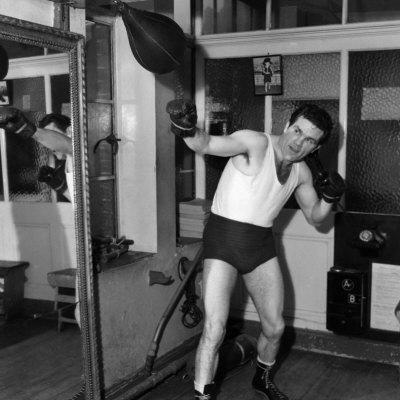
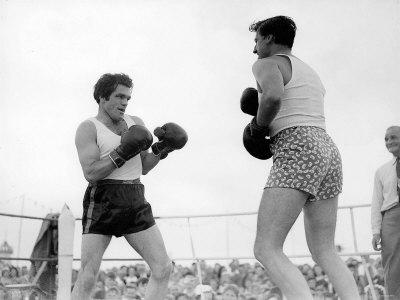
| Freddie Mills Boxing can be two very different sports. On the one hand you had Freddie Mills; a kind of Rocky for real. Always going forward no matter how big the opponent (as a light heavyweight he also fought heavyweights), fighting fighting fighting. Just getting the punch off no matter if he got hurt - a heart as big as the Atlantic Ocean. He possessed a rough style but boy was it mesmerizing to watch. No wonder he was one of the most popular sportsmen with the British public Then you have Audley Harrison. Freddie was everything Harrison could never be. It might as well be a different sport. And I for one now who I'd pay to see. Real name: Frederick Percival Mills Boxing record PERPETUAL MOTION: He grew up in Bournemouth and when he moved to London lived in Denmark Hill, South London, right up until his death. From an early age he wanted to be a boxer. His mother allowed him to do so but it was without her blessing. He started in fairground booths and progressed to capture national attention as in all his fights he was perpetual motion, always coming forward. He served in the RAF during the 2nd World War. Apart from his win against Jack London in 1941, his first wins of note were the two against Jock McAvoy, the 2nd of which, at the Royal Albert Hall, acted as a final eliminator for the British light-heavyweight title. Then it was on to the great Len Harvey for the British and Commonwealth light-heavyweight titles. They met in June 1942. White Hart Lane, Tottenham. 30,000 fans. Mills won in two, knocking Harvey clean out of the ropes and onto the grass. The ending really has to be seen to be believe. Running out of light heavyweights he had to move up to Heavyweight, conceding vast amounts of weight to much bigger men. For example In 1944 he lost another fight with London who was over three stones heavier. Soon after, he was posted to India as a light entertainer, a skill he was to make use of later. Have you heard any of his anecdotes he used at speaking events after his retirement? They are hilarious, self-deprecating and among the best you will hear from any sportsman. For example, in one fight he was taking a massive beating. When he returns to his corner at the end of a round his trainer gives him his best advice to get out of the fight alive: "Don't worry, Freddie. You'll think of something!" He didn't. Anyway, his time in India seriously weakened him when he got a shot at the world light-heavyweight title when he was matched with the current champion, Gus Lesnevich, an American (who he became friends with and flew across the Pond when Mills was reluctantly the star of This Is Your Life in retirement). Harringay Arena. 11,000 fans. Lesnevich heavily floored him in the second. Semi-concussed him. Surprising in this state Mills actually thought about defense and boxed beautifully up to round 10. Freddie himself later said he fought far better in a semi-concussed state. Lesnevich was cut above the eyes but the semi-concussed state lifted by round ten and the result was Lesnevich scored two knockdowns and forced the referee to stop the contest. Unbelievably now but just three weeks after this brutal fight Mills was back in the ring. British heavyweight Bruce Woodcock, a fight he lost on points. Another loss came against another heavyweight, American Joe Baksi. In 1947 he won the vacant European light-heavyweight title against the Belgian, Pol Goffaux, winning by a knockout in the fourth round. A two round win against the Spaniard Paco Bueno followed. In July 1948 he finally won a world title. White City Stadium, London. 46,000 crowd. His old foe, Gus Lesnevich. Mills won on points. He lost again to the heavyweight Woodcock in 1949 when challenging him for his British, Commonwealth and European heavyweight titles. In 1950 defended his world title against a truly world class fighter, Joey Maxim. It was a brutal affair. Mills lost three teeth and was counted out in round ten. He was world champion no more and a few weeks later retired from the ring. Utilising the popularity generated from his efforts in the ring as well as from possessing one of the most engaging personalities in the history of British sport, Mills became a celebrity. He appeared in small parts in a number of films as well as a presenter on the BBC pop-music programme Six-Five Special alongside a youthful Pete Murray. He was great friends with Dickie Henderson. He had married Marie McCorkindale in 1948 in Herne Hill. She had previously been married to the boxer Donald McCorkindale and had a son by him. Remarkably all four would go on holiday together! The couple went on to have two two daughters together. He opened a nightclub in Soho and became friends with the Kray Twins. By 1965 the club was doing badly.He was found dead in his car in a Soho alley by the nightclub, shot through the eye with a rifle. The official verdict was suicide - something his family refused to beliece. The respected detective Nipper Reed maintained it was suicide but he left no note and the whole event is shrouded in a mystery that is unlikely ever to be explained. Did he pull the trigger or did someone else. There have been so many theories that it is hard to make sense of it all. I have heard the allegations that he was about to be revealed as Jack The Stripper but they seem to be so far-fetched as to be laughable. He is buried at Camberwell New Cemetery, South London. Paul Page, December, 2012 FURTHER READING: Who Killed Freddie Mills?: A Full-scale Insider's Investigation of British Sport's Most Baffling Crime These prints are available at ebay.com but even more exciting: Freddie Mills signed items @ ebay.com (direct link to signed items) - grab yourself a Mills treasure Freddie Mills signed items @ ebay.com (direct link to signed items) - grab yourself a Mills treasure |