Film Review
Year: 1950
Producer: Andre Paulve and Films du Palais-Royal
Cinematographer: Nicolas Hayer
Scenario & Director: Jean Cocteau
Music: Georges Auric
Sound: J. Calvet
Cast: Jean Marais (Orpheus), Maria Casares (Princess), Marie Dea (Eurydice), François Perier (Heurtebise), Juliette Greco (Aglaonice), Edouard Dermit (Cegeste)
Filmed: Fall of 1949
Premiere: Cannes, March 1, 1950
Awards: International Critics' Prize, Venice, 1950
In 1949 Cocteau, sixty years old but toujours vert, began to film the screen version of his 1926 play Orphée.
Both Jean Marais and Edouard Dermit appeared in the movie. Marais as Orpheus (the older poet) and Dermit as Cégeste (the younger poet). María Casares, one of Cocteau's favourite actresses, played the Princess (Death).
Cocteau wrote to his English translator, Mary Hoeck, explaining that the moral of Orphée was the engagement of the poet with himself, not with causes or parties. Such intransigence, continued Cocteau, creates chaos in the world, and so in the film Death, although in love with Orpheus, sacrifices her own feelings and allows the poet to remain on earth.
Original and reproduction posters from Orphée and other classics
In one scene in the film, at the entrance to the Cafe des Poetes, Dermit/Cégeste comes in as Marais/Orphée goes out. They pause, and Cégeste mutters scornfully at Orphée. That instant on screen is a Coctelian reference to a state of tension that prevailed in the poet's household at the time.
But it also portrays his awareness that by 1949 he was being rejected by the young public, the new generation of Saint-Germain-des-Prés. This anxiety is reconfirmed in the film when two of the Bacchantes attack Orpheus. For the Bacchantes' role, Cocteau chose Juliette Greco and Anne-Marie Cazalis from Le Tabou, one of Saint-Germain-des-Prés most famous caves.
The film was shot largely in the ruined buildings of Saint-Cyr, the French West Point, which had been destroyed by the Germans during World War II in the course of aerial bombardment.
High definition restoration available now
Cocteau's innovations abound: Death rides in a magnificent Rolls-Royce (a visual echo of Francine Weisweiller's Bentley) escorted by a sinister motorcycle police; Orpheus is mesmerized by a car radio that repeats coded messages; and one of the trick mirrors used in the film was actually a thousand-pound tub of mercury.
In September of 1950 Orphée won the Prix International de la Critique at the Venice Film Festival, and in 1951 it took First Prize at the Cannes Film Festival.
A footnote to the creator's satisfaction was a review by Claude Mauriac finally acclaiming Cocteau as a great filmmaker and writer.
This magical retelling of the Orpheus myth turns the lyre-playing singer of Greek legend into a famous left-bank poet in post-war Paris. Fallen out of favour and lost for poetic inspiration, Orphée becomes obsessed with a mysterious black-clad princess who first claims the life of a rival poet, and then Eurydice, his wife.
With its unforgettable imagery—the dissolving mirror through which characters pass into the next world, the leather-clad, death-dealing motorcyclists, and Cocteau's magical special effects—Orphée is a work of haunting beauty that follows the poetic logic of a dream.

Film Trivia
Music again from the soundtrack master, Georges Auric.
Marie Déa (Eurydice) was born Odette Alice Marie Deupès in 1912. Died in Paris 1992. Married to Lucien Nat (1895–1972).
Jean Marais died in 1998.
The hypnotic María Casares's death preceded Marais's by two years. Casares would also appear in Le Testament d'Orphée some ten years later. I can think of no actress more spellbindingly watchable than her. And that includes Garbo & Dietrich who, if the reports are correct, were approached to play her role. She blows all away.
Edouard Dermithe, Cocteau's adopted son, died in 1995, some three years before Marais.
For the scene in which Orphée passes his hand through a glass pane, Cocteau used a vat of mercury to create the effect. Cocteau: "Mirrors: we watch ourselves grow old in mirrors. They bring us closer to death".
Orphée was the second time that Cocteau explored the Orpheus myth in film. He had previously utilised the myth in 1930 for The Blood of a Poet (Le Sang d'un poète) and would return to it in 1960 with The Testament of Orpheus (Le Testament d'Orphée).
One of the radio transmissions in the Rolls is a line from Apollinaire: "L'Oiseau chante avec ses doights".
Dermithe was originally employed by Cocteau as a gardener but would fulfil his artistic potential (as an actor and painter) under Cocteau's tutelage. It was doubtless Dermithe's extraordinary physical beauty that first attracted Cocteau to him, as a muse and lover, but he was also the man to whom Cocteau entrusted his artistic legacy, by adopting him as his son and making him his heir.
Both Marlene Dietrich and Greta Garbo were approached about playing the mysterious Princess. Both declined.
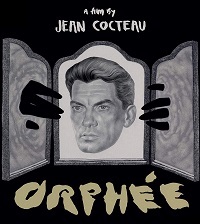
The opening credits were drawn by Jean Cocteau himself. The lightness of touch is something that has always drawn me to his work and led me to his films and books.
Beautiful Cocteau ceramics, plates, and decorative art
Blu-ray Edition
Format: Dolby, PAL
Region: Region B/2
Number of discs: 1
Classification: PG
Studio: BFI
DVD Release Date: 28 Jan
DVD Release Date: 28 Jan. 2019
Run Time: 96 minutes
Poet, playwright, artist and filmmaker, Jean Cocteau was one of the most significant artists of the twentieth century and Orphée his finest work of cinema.
This magical retelling of the Orpheus myth turns the lyre-playing singer of Greek legend into a famous left-bank poet in post-war Paris. Fallen out of favour and lost for poetic inspiration, Orphée becomes obsessed with a mysterious black-clad princess who first claims the life of a rival poet, and then Eurydice, his wife.
With its unforgettable imagery—the dissolving mirror through which characters pass into the next world, the leather-clad, death-dealing motorcyclists, and Cocteau's magical special effects—Orphée is a work of haunting beauty that follows the poetic logic of dream.
Special Features
Presented in High Definition
Feature-length commentary by Roland-François Lack
Jean Cocteau by Pierre Bergé and Dominque Marny (2008, 35 mins)
Memories of Filming by Jean-Pierre Mocky and Eric Le Roy (2008, 16 mins)
Jean Cocteau and His Tricks (2008, 14 mins)
The Queer Family Tree - Reflections on Jean Cocteau (2018, 15 mins)
La villa Santo Sospir (1952, 38 mins)
Theatrical trailer
2018 Re-release trailer
Stills Gallery
Illustrated booklet featuring essays by Ginette Vincendeau, Deborah Allison, William Fowler and Sarah Wood
High definition restoration with extensive special features

All images © Estate of Jean Cocteau