MICHAEL ANDREWS

1928 - 1995

British Painter • Ayers Rock Series • Portraits & Landscapes
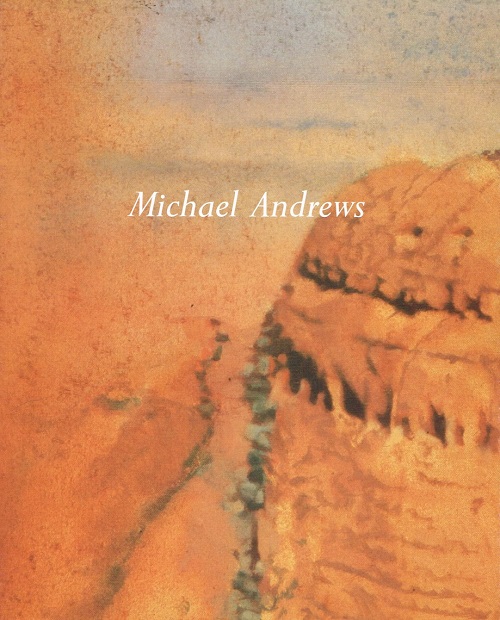
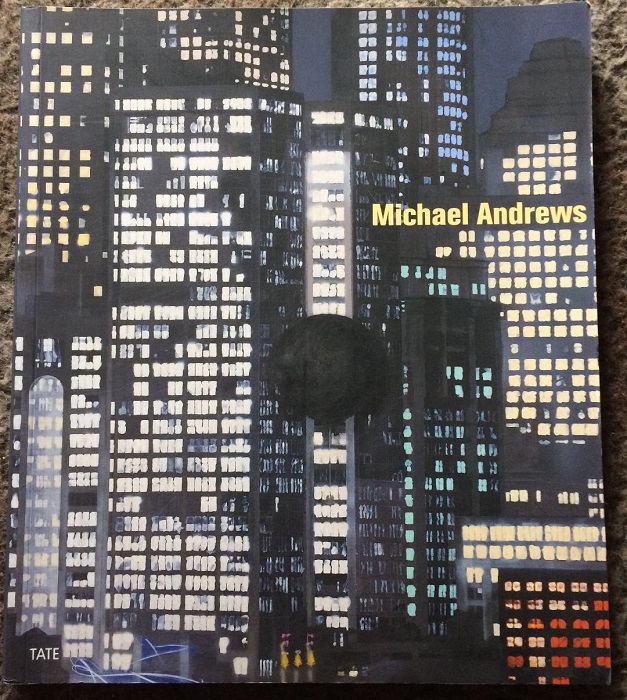
Michael Andrews Delectable Mountain Michael Andrews Tate Book
Michael Andrews: The Delectable Mountain - Whitechapel Catalogue (1991)
Featured Books

The Delectable Mountain (1991)

Whitechapel Gallery catalogue - Ayers Rock series

View Details →

Tate Britain Book (2001)

Major retrospective exhibition catalogue

View Details →

Biography

"There is such visual poetry in his output that once seen (preferably in the flesh but reproduction like this are no bad substitute) it is never forgotten. Maybe it is gentle but there is something good in that as a counterpoint to Bacon's awesome brutality, Auerbach's and Kossoff's frenetic intensity, Hockney's mercurial brilliance or Freud's overwhelming beauty. It has a subtle charm seldom seen in art or indeed in life these days."

It's over 20 years since this wonderful artist's death in 1995 and his status as one of the great British artists of the 2nd half of the 20th century seems to have lagged behind those of his peers: Bacon, Freud, Auerbach, Hockney and Kossoff. And yet it shouldn't as there is such visual poetry in his output.

Exhilarating.

I think his 'lagging behind' is due to his relatively early death and for the fact he was a comparatively quiet artist. By the time Bacon shuffled off this mortal coil his bigness was firmly in the mainstream. Big artist, big head, big themes and a big, big life. Auerbach was and is quieter and Kossoff the quietest and yet in the last 20 years or so the big guys of art have accorded them big retrospectives and their fame has increased; Hockney has big bright colours which the public just love to colour in their lives and Freud was always a superstar in life and art and no-one was going to stop his star from shining brightest. There is no such thing as 'ugly' in his work.

So he has kind of been crowded out by the in-crowd of British art and by the fact that time has accorded his peers the recognition their work deserves. But the memory of his work lingers on for many and caresses and seduces you with its colour like the bright colours of Heaven as visualised in the way Jack Cardiff used it in those old classic movies by Powell and Pressburger. And, just a hunch, but I think sometime soon that recognition will catch up with him and place him back where he belongs - at the high table of 20th century British art.

Key Dates

  • 1928 - Born in Norwich
  • 1949-53 - Studied at Slade School of Fine Art
  • 1953 - Rome Scholarship in Painting
  • 1961 - Gulbenkian Purchase Award; Lived and worked in Norfolk
  • 1995 - Died in London from cancer. Survived by wife June Andrews

One-Man Exhibitions

  • 1958 - Beaux Art Gallery
  • 1963 - Beaux Art Gallery
  • 1974 - Anthony d'Offay Gallery
  • 1978 - Anthony d'Offay Gallery
  • 1980-81 - Retrospective Exhibition, Arts Council of Great Britain, Hayward Gallery, London, Fruit Market Gallery, Edinburgh and Whitworth Art Gallery, University of Manchester
  • 2001 - Tate Britain

Uluru (Ayers Rock) Series - Trivia

One of my fascinations with the late Michael Andrews is Uluru (Ayers Rock) and his fascination with Uluru. In the 1980s he visited there and produced pieces that really, really capture the mysticism of the place.

  • His studio at Saxlingham Nethergate in Norfolk was a former chapel where he had a photograph of the Zen garden of Ryoan-ji in Kyoto.
  • The Cathedral is the flagship of the Ayers Rock series by Andrews.
  • The first white man to see Uluru was Ernest Giles in 1872.
  • The first to climb it was William Christie Gosse who, in 1873, named it after the Premier of South Australia, Sir Henry Ayers.
  • Michael Andrews arrived in the Uluru National Park, via Alice Springs, in October 1983. He checked into the Uluru Motel and spent ten days at the Rock and at Katatjuja, a group of lesser lumps twenty miles to the West, named the Olgas after a Russian Grand Duchess. Since his visit the motel has been pulled down.
  • The acrylic on canvasses from the Ayers Rock series and surrounding areas are huge, up to 9ft each. By contrast, the watercolours, which were done on the spot, are roughly 15" x 10" inches each.
  • For the series, Andrews used handfuls of red sand he brought from the Rock to roughen surfaces. That fact alone, Ayers & Andrews, made the series to me almost sacred.
  • In 1963, a chain hand-rail was fixed to the slope of Uluru by the Uluru National park. Since then, 50,000 people a year have climbed to the summit. Bronze plaques on the base of the Rock commemorate those who died from falls or heart attacks. Andrews himself did the climb (and shared his painting-water at the cairn with two thirsty pilots). Once at the summit he did no drawing.
  • Every mark on the abrasive surface of the Rock, every blemish and fissure has aboriginal meaning. Uluru's scabs are signs of ancient rivalries.
  • Valley of the Winds was the third in the series by Andrews to be completed.
Books & Catalogues

Rare Exhibition Catalogues & Monographs

The Delectable Mountain (1991)

Whitechapel Gallery exhibition catalogue. Collection from the celebrated Ayers Rock series of paintings.

View Details →

Tate Britain Book (2001)

Major retrospective exhibition catalogue from Tate Britain's comprehensive survey of Andrews' work.

View Details →

Earth, Air, Water (2017)

Recent catalogue exploring Andrews' relationship with natural elements and landscape.

View Details →

Rock of Ages Cleft For Me (1986)

Recent Paintings by Michael Andrews. Important early catalogue of mature work.

View Details →

Lights Exhibition Catalogue (2000)

Rare catalogue exploring Andrews' use of light and atmosphere in his paintings.

View Details →

Arts Council Catalogue (1981)

Retrospective exhibition catalogue from the Arts Council of Great Britain.

View Details →

All images © The Estate of Michael Andrews