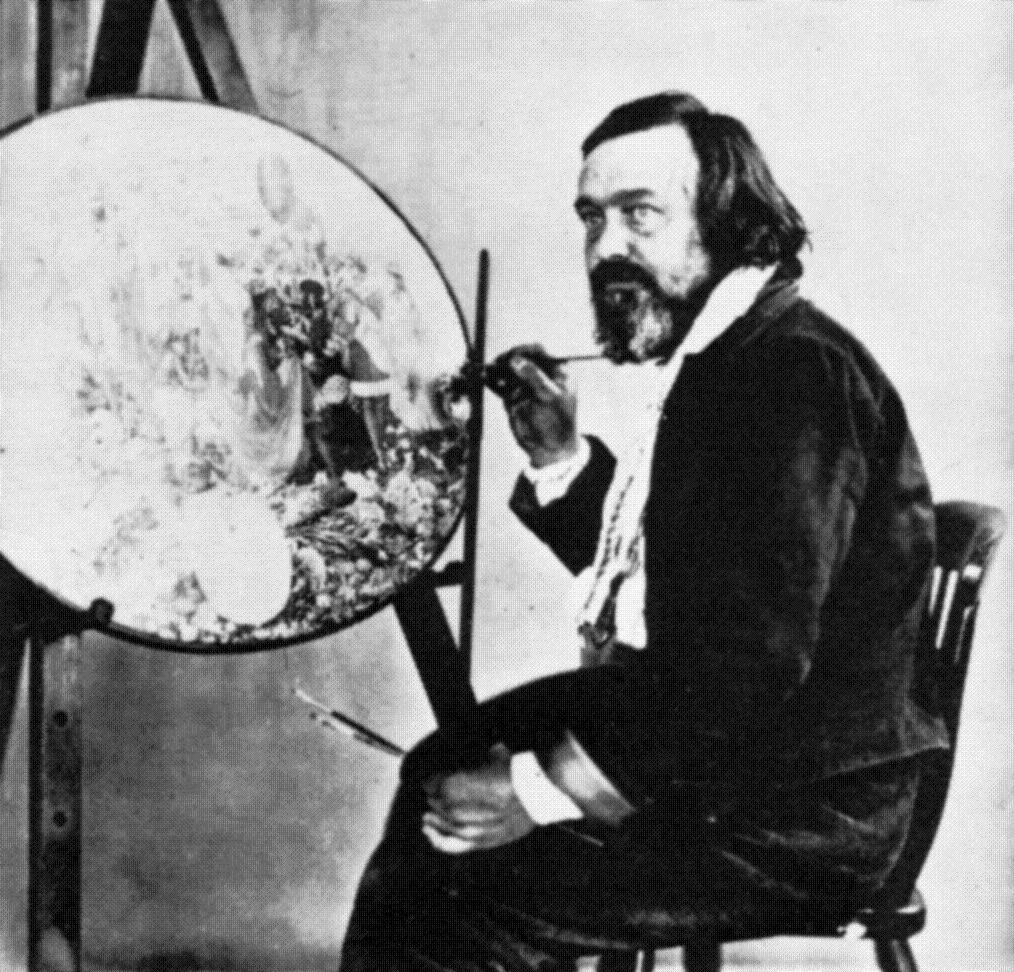
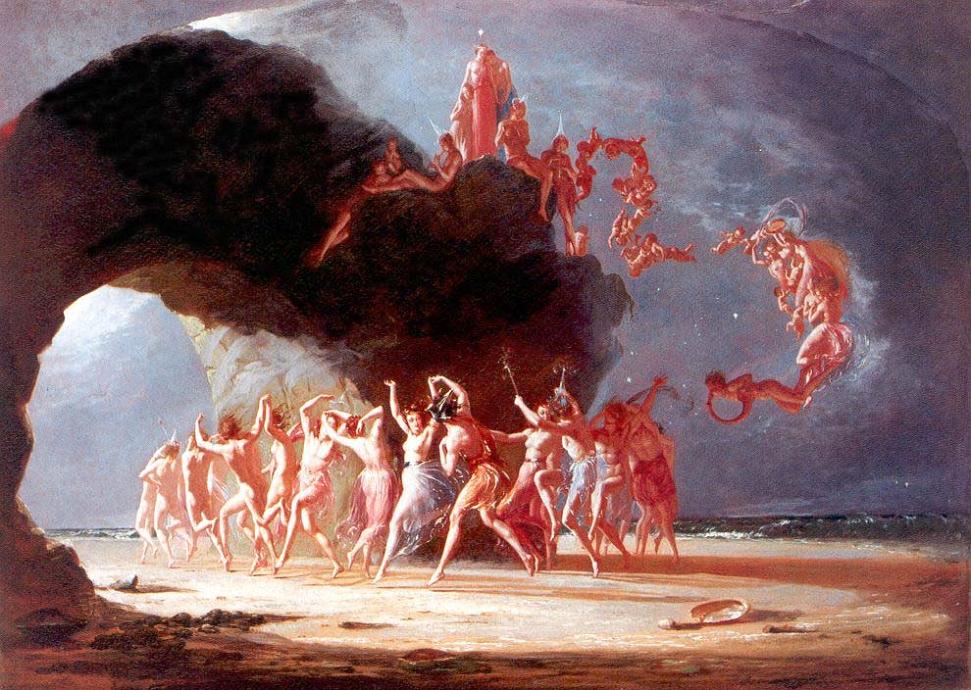
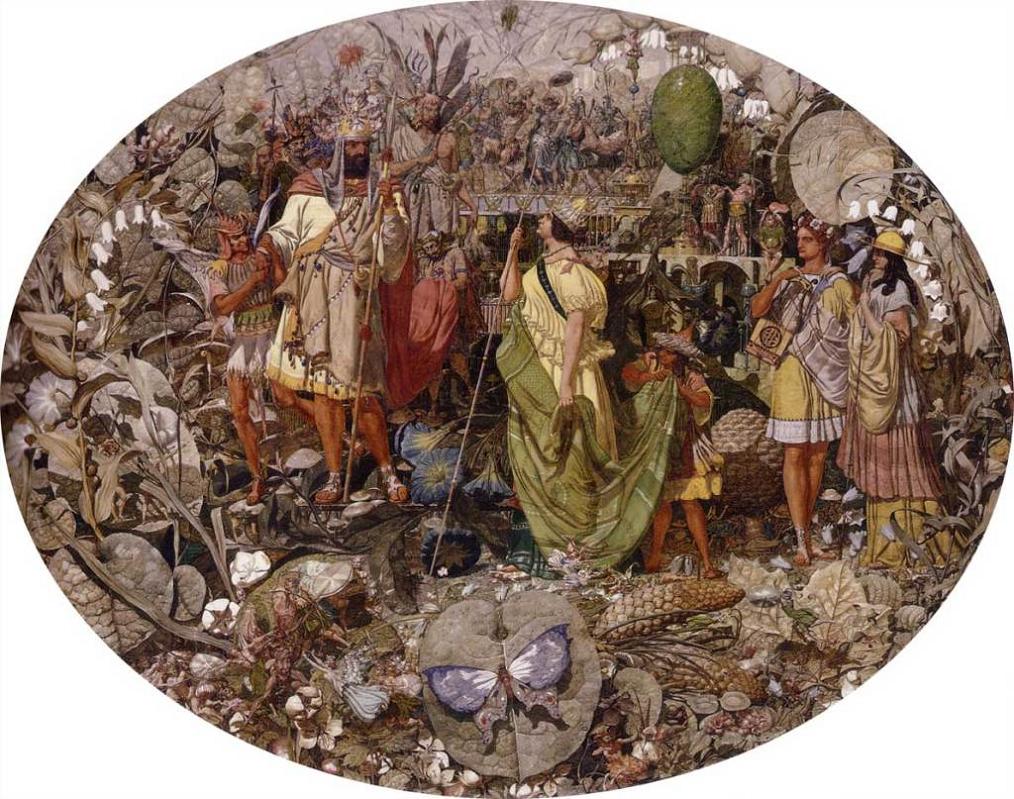
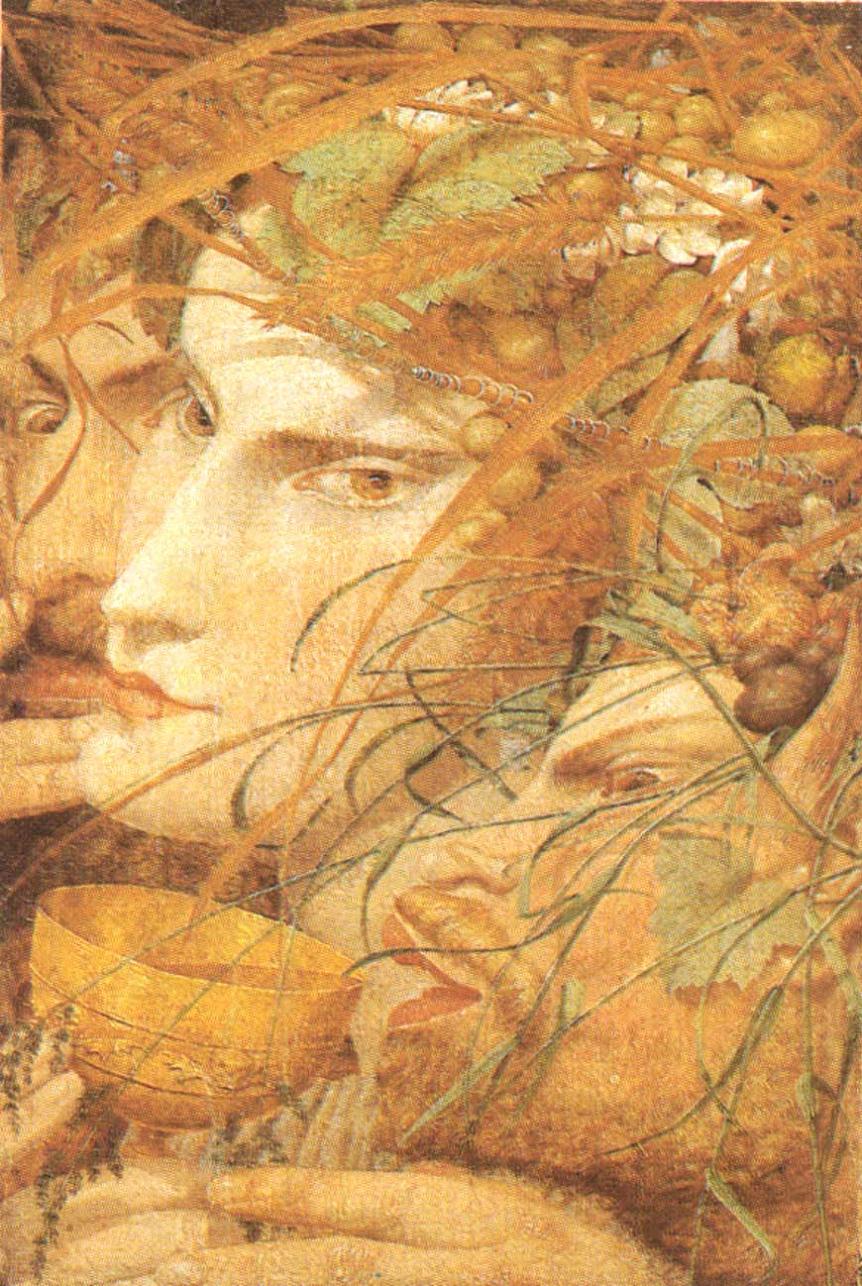
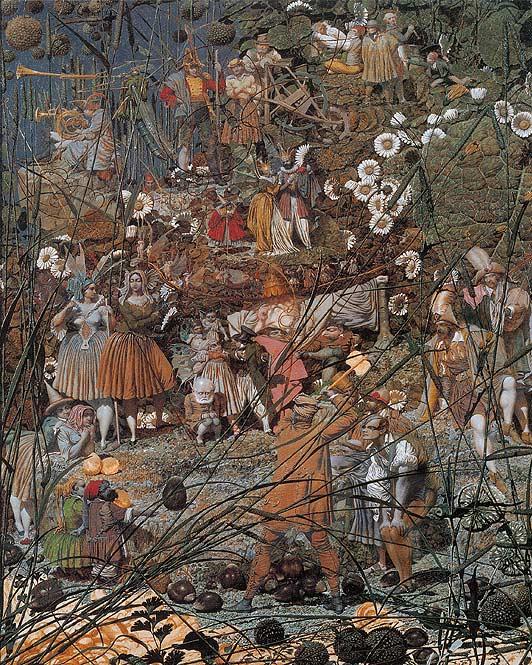
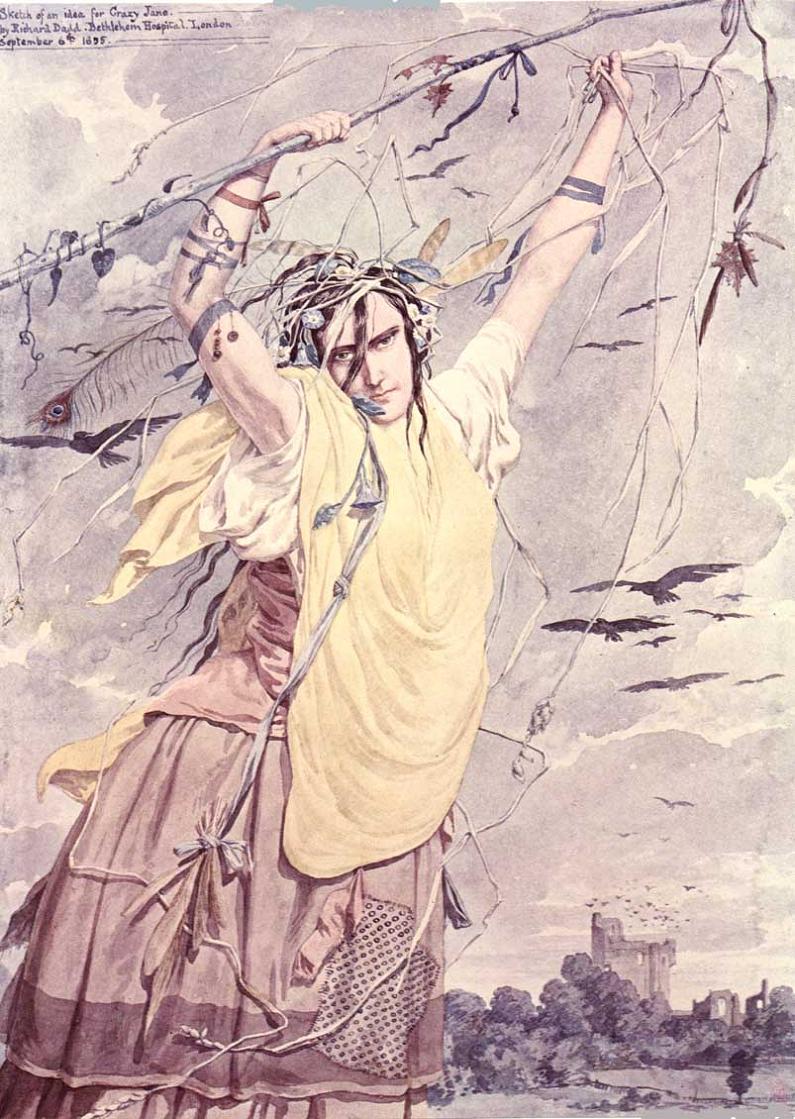
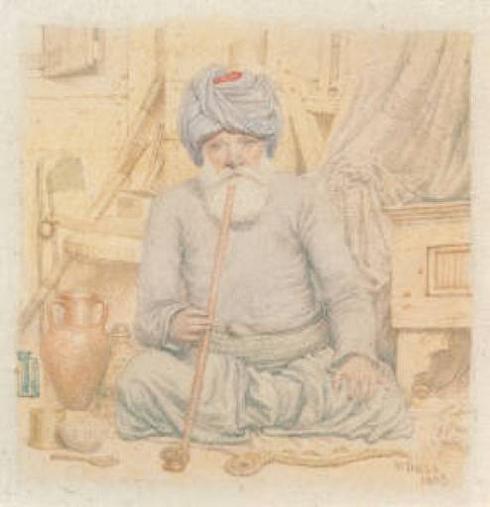
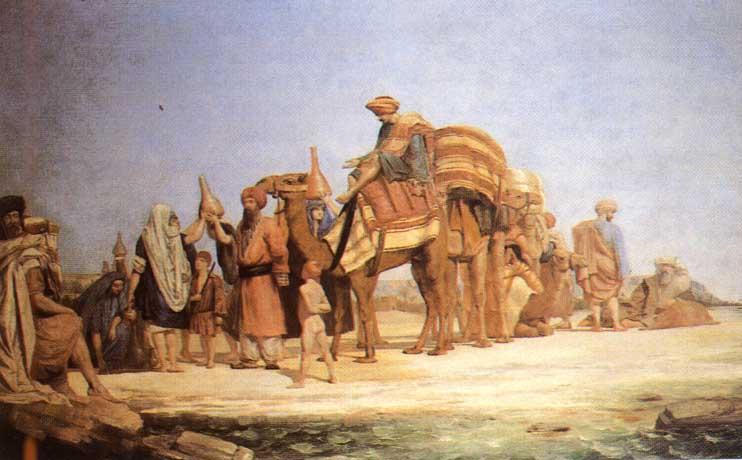
| Richard Dadd 1817-86 Exhibition runs from 28 May - 2 October 2011 Dadd returned to London and murdered his father. Committed as insane in 1844, Dadd spent the rest of his life in care. In London's Bethlem Hospital he painted his meticulously worked oils Oberon and Titania (1854-8; private collection) and the The Faery Feller's Master Stroke (1855-64; Tate Gallery, London). In 1864 he was moved to Broadmoor; he continued to paint well on into the 1880s. The young artists met weekly at Dadd's rooms, where they spent an hour or two sketching subjects drawn in the main from Shakespeare or Byron, after which one of the guests would choose the best drawing. Dadd, generally acknowledged to be the finest draughtsman, often undertook character portraits of members of the group. The evenings ended with a light supper of bread, cheese and beer. At one of their meetings, they mapped out their futures, as young men will: 'Frith said he intended to paint pictures of ordinary life, such as would take with the public. O'Neil determined on painting incidents of striking character, appealing to the feelings, and Phillip desired to illustrate incidents in the lives of famous persons. Dadd proposed to devote himself to works of the imagination.' In this ambition he was to succeed beyond his wildest dreams. Dadd was born in 1817 at Chatham in Kent where his father was a chemist. When in 1837 he entered the Royal Academy Schools, with a recommendation from Clarkson Stansfield, his father moved to London to provide him with a home. Dadd exhibited portraits and landscapes at the Academy and elsewhere until 1841, when he gained a major commission to paint a large number of panels for a nobleman's house in Grosvenor Square, some of the subjects being drawn from Byron's Manfred. The only known account of them describes how 'the Alpine mist or smoke about Manfred's head [was] ... composed of minute figures of men and women, explained by Dadd to be ideas formed and unformed, as their outlines were distinct or indistinct.' At the summer exhibitions of the Royal Academy that year Dadd exhibited one of his first important fairy paintings, Come unto these Yellow Sands, with the lines from Ariel's song in The Tempest: In July 1842, recommended by David Roberts, Dadd accompanied Sir Thomas Phillips on an expedition to Egypt and Asia Minor. He painted many vivid watercolours of picturesque views but gradually, after a bad sun-stroke at Thebes, became more and more disturbed. It now seems likely, however, that this was only a contributory factor to his condition, which we would today describe as paranoid schizophrenia. On the return jouney the party visited Rome, where Dadd felt a strong inclination to attack the Pope 'in a public place', but 'overcame the desire' as the Pontiff was so well protected. In Paris, rather than see a doctor he fled back to London, where he arrived in April 1843 in time to submit a cartoon for Westminister of St. George after the death of the dragon which, according to Frith, had an inordinately long tail. Stress and turmoil continued to assail him, and he became convinced that he was constantly being watched, a classic sympton of a persecution complex. His dementia grew until at the end of August he purchased a newcut-throat razor, which he used to kill his devoted father in Cobham Park. Dadd fled to France but was detained in Paris after trying to kill a fellow passenger on a coach, who was, he said, possessed by a devil. He remained in France for ten months before being returned to London, where he admitted his crime, claiming to be descended from the Egyptian god Osiris who had ordered him to kill his father who was possessed by the devil. On 22 August 1844 he was admitted to Bethlem Hospital, aged 27. Amazingly, most of his best work would be painted in the next forty-two years, at first at Bethlem and later at Broadmoor. From an early date he seems to have been given access to both watercolours and oils. He used the watercolours to paint a long series of works dealing with various human passions, and the oils to create his two masterpieces, Contradiction: Oberon and Titinia, the labour of four years from 1854 to 1858, and The Fairy Feller's Master-Stroke, on which he worked from 1857 to 1864. In The Fairy Feller our first visual impression of the work is akin to the sense of wonder when we lift a flagstone and stare down at the myriad activities of the insect world concealed underneath. Long grasses slant from side to side across the picture's surface, carpeted with hare bells, convolvulus, hazel-nuts and daisies, and a butterfly rests on a leaf. The fairy feller himself stands at the bottom right of the picture, with his primitive stone axe poised to split a nut to form a new chariot for Queen Mab. The complex cast of dwarves, fairies and figures, drawn from Dadd's watercolour works called The Passions, all stand motionless awaiting the fall of the axe, a complete world frozen in suspense. Dadd wrote a long commentary to accompany the painting, entitled An Elimination and dated January 1865, in which he asks us to forgive his fancies: 'You can afford to let this go for naught or nothing it explains. And nothing from nothing nothing gains.' Devoid of female companionship, he describes the loneliness of his own lot 'shut out from nature's game, banished from nature's book of life'. He died in January 1886. |
 , and the curator of the exhibition has very kindly sent a few scans of some pieces which will be exhibited and which because they have been in private collections have rarely been seen. Whets the appetites