Facts
Born Winona Horowitz to two hippies thoroughly "into the pudding", she grew up surrounded by some of the brightest lights of the counterculture.
Timothy Leary was her godfather
(her father Michael Horowitz
disavows any involvement with the acid guru's 1970 prison
breakout, giving full credit to the radical
Weathermen), and Allen Ginsberg
often dropped by the Mendocino commune
where she lived for four years enjoying a
life without TV (without electricity!)
that turned her onto books. Money was scarce, but
love was in abundance. Yet when the family finally
settled in Petaluma, California, she discovered that her
years "on the bus" set her apart from her
peers, and this experience as a
"suburban reject" would help inform some
of her best work from Beetlejuice
(1988) to Girl, Interrupted
(1999). Her parents promptly curtailed
the public school experiment and to add
spice to her home study program enrolled
her in acting classes at San Francisco's American Conservatory Theatre.
Spotted there by a talent scout and screen
tested for a role in Desert Bloom
(1986), Ryder lost out to Annabeth Gish,
but her audition tape found its way to director David Seltzer
who cast her in the underrated Lucas.
The following year she played a Texas
teenager torn between her
grandfather (Jason
Robards) and her mother (Jane
Alexander) in Square Dance
and walked away with the best reviews,
setting the stage for her first
collaboration with Burton, Beetlejuice (1988).
Ryder nailed her supporting role
as a morose teen with a penchant for
black clothing who is thoroughly
alienated from her suburban parents,
and nearly stole the film from
co-stars Michael Keaton, Alec Baldwin and
Geena Davis with her low-key, perfectly deadpan vocal delivery. Further solidifying her reputation as a queen of teen
angst with Heathers, she deftly negotiated the
complex terrain as her character advanced from
passive hanger-on to murderer with a conscience,
all the while retaining the audience's affection.
Excellent as the child bride of rock idol
Jerry Lee Lewis (Dennis Quaid)
in Great Balls of Fire! (1989),
she was the sole bright spot as the off-beat
but intelligent Dinky
in the uneven Welcome Home, Roxy Carmichael (1990).
Reteaming with Burton, Ryder
(despite an ill-advised long blonde wig)
delivered a naturalistic portrait of a
young woman at first repulsed then later
drawn to the freakish but
gentle Edward Scissorhands (1990).
Although the director did not depict her
as thoroughly disaffected, he certainly took ample
shots himself at the cookie-cutter
conformity of suburban existence. Rounding out the year
as Cher's
eldest daughter in Mermaids, Ryder
played a neurotic Jewish girl who wants
to become a nun to escape the unconventional
lifestyle of her mother, receiving the film's best
notices and picking up her first acting
award from the National Board of Review.
Though illness reportedly had forced
her out of the pivotal role of
Mary Corleone
in Francis Ford Coppola's The Godfather, Part III
(1990), she got her chance to work with
the director on Bram Stoker's Dracula
(1992). Her pale, sylph-like beauty was
perfect for the period piece, and
Ryder provided the film's emotional
core without being overshadowed by the
film's phantasmagoric special effects,
lavish production design and showier co-stars.
Martin Scorsese
tapped her for another period piece, his remake of
The Age of Innocence (1993), and Ryder
built on the air of sophistication
developed opposite Anthony Hopkins
in Dracula, swooshing around in
hooped dresses and showing some
affinity for the admittedly uncomfortable
bustle. "You can't breathe too well,"
she told journalist Roger D Friedman.
"But when you're that restricted, it makes
your performance more accurate.
The etiquette and dialect, the detail
of the costumes and sets. It makes you feel like
you exist in that time." The actress earned her
first Oscar nomination as Best Supporting Actress
portraying the demure yet strong-willed
May Welland whose fiance
(Daniel Day-Lewis)
has fallen in love with her cousin
(Michelle Pfeiffer).
Ben Stiller's Reality Bites
(1994) offered her the chance to lose the
bustle and don jeans as a Gen-X heroine forced to
choose between a slacker boyfriend
(Ethan Hawke) and a
neurotic workaholic (Stiller).
Though the promising and eccentric tale
of contemporary youth devolved
into a banal love story, Ryder
acquitted herself well in the relatively
thankless role, overshadowing her
co-stars and earning critical praise for her work.
Ryder stepped back into period
garb for Gillian Armstrong's
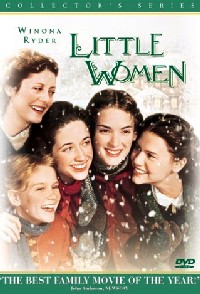
outstanding remake of Little Women (also 1994),
and curious parallels between herself
and the headstrong, bookish Jo March
(an autobiographical representation of the
novel's author Louisa May Alcott)
made her an ideal candidate to play
the 19th Century heroine. Both had grown up
in a close family that lived in a
house with no electricity or running water,
and the utopian Brook Farm, the transcendentalist
settlement that Alcott's
father Bronson
helped establish, bore more than a
passing resemblance to the Mendocino commune of
Ryder's
youth. As ringleader of the spirited Little Women,
she delivered a strong performance in
what is arguably the best screen
rendition of the novel, garnering her second
Oscar nomination (this time as
Best Actress). She went on to essay a
graduate student who learns about
life and love in How to Make an American Quilt
(1995) and tried her hand at
Shakespeare with a turn as Lady Anne
in Al Pacino's
award-winning documentary Looking for Richard (1996).
Again cast opposite Day-Lewis
in the film version of Arthur Miller's The
Crucible (also 1996), Ryder
proved her mettle as the unsympathetic Abigail,
a scorned woman who seeks revenge by
fabricating tales of witchcraft.
Attempting to stretch as a performer,
she took on her first action-adventure role,
teaming with a clone of Ripley
(Sigourney Weaver)
to battle the monsters
of the Alien franchise's
fourth installment, Alien Resurrection
(1997), then stayed on the sidelines for
the next two years except for a small
but luminous role in Woody Allen's
Celebrity (1998). When she next turned up
it was as executive producer and
star of Girl, Interrupted (1999),
based on Susanna Kaysen's
memoir of her experience at a mental hospital in the 60s.
Drawing on her own brief commitment in the
early 90s, Ryder rose above the
script's limitations to credibly render the rich,
spoiled and confused 17-year-old,
though Angelina Jolie trumped
her as the irrepressible sociopath
more responsible for Susanna's
rehabilitation than the doctors.
The following year saw her
star in the exorcism thriller Lost Souls
(the feature directorial
debut of cinematographer Janusz Kaminski)
and Autumn in New York, in which she played a
dying woman romanced by a playboy
(Richard Gere) under the
guidance of director Joan Chen. The film garnered few critical thumbs-up and even fewer ticket sales.
By the end of 2001, it appeared that Winona Ryder
had lost some of her ability to generate
big box office revenues. However, she also proved that she
had not lost her ability to generate headlines: on Dec. 12, 2001,
the actress was detained by security
employees at the Saks Fifth Avenue department store in Beverly Hills
after she had been captured on videotape and
observed by security guards shoplifting
nearly $6,000 worth of the swanky store's
high-end merchandise, cutting off
sensor tags and secreting the items in shopping
bags. Her subsequent arrest and court case
captured the attention of the media-both
mainstream and tabloid-who were soon watching
her every move and clamoring for seats to
attend her Beverly Hills hearings. Denying all the charges,
Ryder spoofed her arrest while out on
bail awaiting her day in court, appearing on
the late-night sketch comedy series Saturday Night Live
(with the tag line "She'll steal your heart") and posing for the
cover of W magazine wearing a Free Winona" t-shirt,
an item that became trendy during her
shoplifting saga.
Meanwhile, two films featuring the actress, the
Adam Sandler comedy Mr. Deeds
and the CGI-inspired Hollywood
morality fable Simone, came and went at the
box office with much fanfare but lukewarm grosses.
Ryder's trial commenced on Oct. 24, 2002,
and in a strange quirk of fate one of the
jurors was producer Peter Guber, a former studio head who
gave the greenlight to
three films starring Ryder (Dracula, The Age of
Innocence and Little Women)
while he was the co-head of Sony Studios
in the early 1990s. The actress' attorney argued
that Ryder had bought several items
prior to her arrest and instructed a
salesperson to keep her account open
(no evidence that she had such an arrangement was presented);
further, he argued that Saks employees had targeted the
actress in hopes of selling the story of her arrest.
Prosecutors successfully refuted the conspiracy claims and
on Nov. 6, 2002, Ryder
was convicted of two of the three charges against her: theft and vandalism.