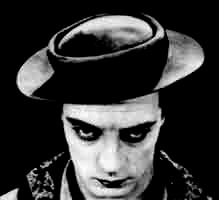
BUSTER KEATON Biography (1895 - 1966) More: Details Icon. Biography | Facts | Filmography | Prints | The General UK Dvd set (2005) | Complete Short Films 1917-1923 Dvd Review | Buster Keaton Video On Demand: Rent or Buy | Search Site "Tragedy is a close-up; comedy, a long shot." Facts The Great Stone Face Natalie Talmadge (31 May 1921 - 25 July 1932) (divorced) 2 children Biography Buster Keaton The Great Stone Face Buster Keaton autographs, photographs and more @ ebay.com (direct link to signed items) - just checked and a great selection Keaton was the comic who greeted the hostile world without a flicker of emotion, and overcame its physical hazards with a series of breathtaking but coolly calculated stunts. His refusal - or inability - to register either elation or despair must have stemmed from a belief that triumph and tragedy inevitably follow each other, and that neither is worth getting excited about He came to the Venice Film Festival in September 1965 when they presented SamuelBeckett's Film, directed by Alan Schneider and starring Buster Keaton. He came down the aisle as the audience applauded him after the morning press show, a tiny solemn figure in a precarious state of preservation, with the urbane Los Angeles theatre-owner Raymond Rohauer like a puppet-master at his elbow. On the big screen his face, only revealed at the end of Beckett's work, bore the imprint of a terrible despair: in the flesh, too, there was nothing reassuring about his frailty. What did he think of the film which, seemingly at odds with his life's work, was in no way a comedy?: 'What I think it means is that a man can keep away from everybody, but he can't get away from himself.' Within five months, at the age of 70, Buster died. As some consolation, it could be said that Keaton had been able to witness at least a part of the restoration of his true status in screen history, a process which has continued steadily since the Sixties thanks to Rohauer's tireless cataloguing of copyrights, resurrection of prints, and licensing of commercial reissues. Not that The Navigator (1924) and The General (1926) were unknown in Europe (the British Film Institute had maintained them in its library and programmed them at the National Film Theatre for years), but the full perspective of Keaton's creative genius had been impossible to assess. It wasn't until a decadeafter his death that, for instance, The Cameraman (1928), narrowly rescued by MGM from negative decay, reappeared in Britain, and Spite Marriage (1929) was revived at the London Film Festival. Where Charles Chaplin has never been forgotten and Harold Lloyd has somehow never needed protection, Keaton had become thought of by the mid-Thirties as a mere pie-throwing extra from the Mack Sennett days. While he was seldom out of work.and apparently accepted his anonymity without rancour, his downfall followed the classic path (also trodden by Georges Melies and D.W. Griffith among others) in being both ill-deserved and unavoidable. Born in a Trunk Joseph Francis Keaton was born on October 4, 1895, the year in which cinema, too, was just beginning. His parents were members of the Mohawk Indian Medicine Company, a travelling vaudeville show, along with Harry Houdini, escapologist extraordinary, and were in Kansas when the baby arrived. Joe H. Keaton was Irish (although maybe with some Indian blood) and a former Wild West adventurer and journalist, whose stories lost nothing in the telling. With his tiny wife Myra, the pipe-smoking, card-playing, musical daughter of a travelling showman, he presented a knockabout acrobatic comedy act into which their son was absorbed shortly after the baby crawled on stage one night to the delightof the audience. Called 'Buster', according to the legend he repeated throughout his life, for having beenpicked up unhurt after falling down a flight of stairs at six months (the experience was referred to by Houdini as a 'buster', the stage slang for pratfall), the boy proved to be the making of 'The Three Keatons': he upstaged his parents by the simple process of being thrown about, walked on, and used as a punchbag. Dressed in the same grotesque wig and sideburns as hisfather, wearing the same dress suit. white waistcoat and spats, he was subjected to such violence that the Keatons were often challenged by legal authorities to prove that 'The Human Mop' was in fact undamaged by his treatment. A typical gag involved his being hit in the face with a broom, his response being several seconds of complete lack of expression before he said 'Ouch!'. From such ordeals, Buster learned comic timing, physical endurance, and above all the discipline of 'freezing' all emotional reaction. ' As early as 1912, 'The Three Keatons' were invited to appear on film, but Joe Keaton would have nothing to do with the nickelodeons which, in his eyes. were devaluing and destroying true theatrical entertainment. But Buster had seen hundreds of films by the time he was 21, and when the end came of the Keaton family show (the result partly of his father's hostility and drunkenness, partly of the fact that, small as he was, Buster was simply too big to be conveniently hurled around), it was an easy step for him to move into two-reelers. After a chance encounter with Fatty Arbuckle in New York, he turned down a Winter Garden Theatre engagement of $250 a week in order to appear in movies at $40 a week, beginning with The Butcher Boy early in April 1917. This was also the first film of Arbuckle's new ComicqueFilm Corporation, supervised by Joseph M. Schenck, and with thesupport and encouragement of both menBuster was immediately spellbound by boththe technical and the creative side of film-making. 'One of the first things I did was tear amotion picture camera practically to piecesand found out the lenses and the splicing offilm and how to get it on the projector - thisfascinated me.' After another five films - A Reckless Romeo, The Rough House, His Wedding Night. Oh. Doctor! and Fatty at Coney Island (all 1917) - the whole team moved to California. It took with it Keaton's family and one of the Talmadge sisters, Natalie. Very much in the shadow of her more famous sisters Norma and Constance, Natalie worked in a secretarial position at the studios where the Keatons met her. She became a special favourite of Myra's. Accidents Will Happen It was a foregone conclusion that Buster and Natalie would marry, not that there weren't many other girls in his life. As part of the Hollywood community, among a dazzling circle of friends including Chaplin, Douglas Fairbanks, W.S. Hart and Rudolph Valentino, the private and habitually non-committal Buster found himself to be, like Arbuckle, very public property, his existence stage-managed for the benefit of the press. His marriage in 1921 gives the impression (as indeed do his two subsequent marriages, to Mae Scribbens in 1933 and to Eleanor Norris in 1940) of having occurred without his full comprehension, like the innumerable natural disasters in his films. With Natalie came the rest of the Talmadge family, who enlisted Louise Keaton (Buster's sister) as a stand-in for Norma, shared the Keaton residence (a huge Italian Villa was built for them all at Beverly Hills in 1925), and determined after the birth of their two sons that Natalie should have no more children. The divorce was not until 1932, a final blow when Keaton's fortunes were already in battered shape, but the marriage had finished years earlier. The Talmadges don't even rate a mention in Keaton's 1960 'autobiography', My Wonderful World of Slapstick. Buster made six two-reelers with Arbuckle in California - A Country Hero (1917), in which Joe Keaton also appeared. Out West, The Bell Boy. Moonshine, Good Night, Nurse! and The Cook (all 1918). He was then drafted in mid-1918 and spent seven months entertaining the troops in France. During this time he caught an ear infection that rendered him partially deaf for the rest of his life. When he returned in 1919, it was to find Arbuckle preparing to move into feature production, though they completed three more two-reelers together - Back Stage, The Hayseed (both 1919), and The Garage (1920). Joseph Schenck then offered Buster his own company on a handshake deal, and what was to be the golden era of Keaton comedy was under way, sadly and ironically aided by the collapse of Arbuckle's separate career following the scandal of 1921. From 1920 to 1923 Keaton made one feature (The Saphead, 1920) and 19 shorts, followed by 10 further features in the five years to 1928 when he changed producer. If it was thanks to his brother-in-law (Schenck was married to Norma Talmadge) that Buster had no shares in his own company and finally made 'the biggest mistake of my life' by moving to MGM, it was also under Schenck's protection that he enjoyed in the last glorious years of silent cinema a seemingly limitless freedom to make whatever he liked, with no budgetary strings and no front-office interference. He was in peak condition as an athlete, he was inexhaustible on less than five hours sleep a night, he could drink copiously without side-effects, and if he needed a steam-engine or an ocean liner, they bought him one.But after this period never again would he have total control of his creativity, and never again would his films reflect the sheer uncluttered exuberance of his comic timing and his magical visual sense. The hallmark of a Keaton comedy is the energy of its central character, all the animation that others display on their faces being expressed by Buster in a headlong ballet of acrobatics which he performed himself, in long-shot and without cuts. There is no trickery about the log-bouncing scene in The General, or Buster's high dive from the top of the ship in The Navigator, or the vaulting ease with which he skims down the riverboat decks in Steamboat Bill Jr (1928) and all the way up again a moment later. In Spite Marriage, a single shot follows his desperate battle with the villain from one end of the luxury yacht to the other where, flung into the ocean, he is carried by the current back to the lifeboat trailing at the stern and hauls himself up over the side to resume the struggle. During his career, as he often reported in later years, he broke every bone in his body. In The Paleface (1921) he dropped 85 feet from a suspension bridge into a net, he was nearly drowned under a waterfall in Our Hospitality (1923), and during the train sequence in Sherlock. Jr (1924) he actually broke his neck yet continued stunting and filming despite months of blinding headaches. where there's a will . . . Nevertheless, it's not as a stuntman but as a unique tragi-comic personality that he survives as the most fascinating of the silent comedians. As if pursuing a redefinition of his private experience, his films illustrate thepurgatorial struggles of an inconsequentialreject, habitually bullied by a scornful father ordisdainfully ignored by an unappreciative girl,who by sheer persistence and ingenuouscourage (physical danger never seems to occurto him as a possibility) battles his way to socialacceptability. In his tenacious war against theforces of evil, his endurance in restoring therightness of things, and his enigmatic face thatgives nothing away - no promises, no denials -he is one of the screen's great martyrs. Yet atthe same time, he has an uncanny gift foradapting technology to provide unexpected comforts; he uses a swordfish for protection, aboiler for a bedroom and a lobster-pot for anegg-holder in The Navigator, lazy tongs for atraffic indicator and a telephone for controllinga horse in Cops (1922), and can whip up a briskasbestos suit in order to survive burning at thestake in The Paleface. As if in reward for hisingenuity, and for his obvious innocence,Providence is on his side, carrying him placidlyoff in an airborn canoe at the end of TheBalloonatic (1923), or dropping the two-tonfacade of a building over his body - he standsexactly where an empty window-frame dropsover him - in that hair-raising shot from Steamboat Bill, Jr (even the cameraman,legend has it, couldn't bear to watch) leavinghim dusty but unscathed. At his best, Keaton's films found their leastenthusiastic audience. While The General lookslike a masterpiece today, it was a disaster whenfirst released. Yet his MGM comedies of theearly Thirties, The Passionate Plumber, SpeakEasily (both 1932) and What! No.Beer? (1933),uneasily teaming him with Jimmy Durante,and contemptuously regarded by Keaton him-self, were huge moneyspinners. He took refugefrom them, and from a movie business becom-ing increasingly incomprehensible, in pro-longed periods of alcoholism, and waitedthrough 17 lacklustre years of mediocrity, bit-parts, and gag-writing for other, lesser comedians, until, with Sunset Boulevard (1950) and Limelight (1952), the world began to notice himagain. Then television provided a new home,and the final decade of his life afforded him acomfortable income from chat-shows, television commercials, and personal appearancesat which, with a growing awareness, hisaudiences showed a genuine interest in thefilms that at first release had been taken socasually for granted. If the magnificent photography was now somewhat dimmed by chemical changes. Buster's own technical virtuositystill took the breath away. And as a symbol ofthe average man, struggling to find his place ina hostile society but unable to 'get away fromhimself, the great stone face speaks today withever-increasing clarity. Filmography As actor only in shorts: As co-director, co-scriptwriter andactor in shorts unless otherwise specified: Features: As actor only unless otherwise specified: Shorts as actor only unless otherwisespecified: Features as actor only unlessotherwise specified: Keaton was uncredited as gag-writer on: Shop VIDEO ON DEMAND - RENT OR BUY: Icon. Biography | Facts | Filmography | Prints | The General UK Dvd set (2005) | Complete Short Films 1917-1923 Dvd Review | Buster Keaton Video On Demand: Rent or Buy | Search Site | Top of Page © Lenin Imports E-mail |