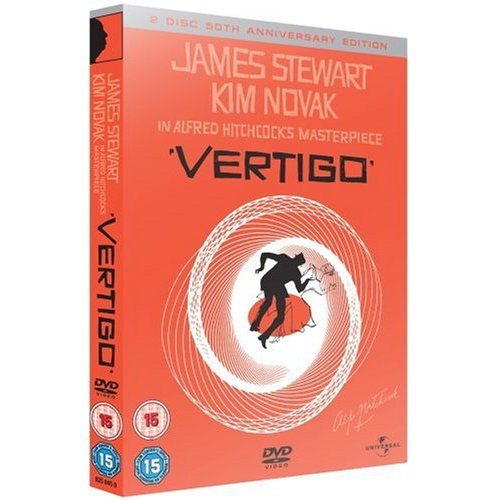
| Vertigo REVIEW More: Details About This Dvd. Buy Dvd | Vertigo Gallery | Vertigo Video On Demand: Rent or Buy | Hitch Movie Reviews | Dvds | Boxsets | Biog. | Search We are based in South London near Croydon, UK, and if preferred this item can be picked up by appointment. Just e-mail here. I also welcome the old fashioned cheque and po as it is cheaper to process and all orders are sent off same day as cheque received. Movie Review - Cast & Crew - Dvd Features - Dvd Technical Details - Buy Dvd - James Stewart's Vertigo - 1 Disc Dvd Some months later he spots a woman (also played by Novak) who bears an uncanny resemblance to the dead woman, and is drawn into a complex web of deceit. Novak gives her greatest performance, while the darker side of Stewart shatters his all-American Mr Nice Guy persona. Stewart's performance is all the more remarkable when you consider that he is on camera almost constantly. Supporting players are all excellent and don't get in the way of the telling of the piece, with Barbara Bel Geddes, in limited role of Stewart's down-to-earth girl friend, standout for providing early dashes of humour. San Francisco location scenes - whether of Nob Hill, interior of Ernie's restaurant, Land's End, downtown, Muir Woods, Mission Dolores or San Juan Baustista - are absolutely authentic and breathtaking. A hallucinatory movie, of dreamlike revelations in its glistening locations, it remains one of the most painful depictions of romantic fatalism in all of cinema. The work of a genius. This is a wonderful book! I wouldn't be without it. If you have ever wanted to retrace the master's steps around the Bay Area and want to learn more about the locations used in this film then this is the perfect companion. The authors' love of the director's work and the city itself is here on every page. Added bonus is that it has a foreword by Hitchcock's daughter. Available: amazon.co.uk Off-camera, the director's manic involvements with hislead actresses took some decidedly nasty turns, first with his badgeringof a pregnant Vera Miles to play his heroine and then with his oftencrude handling of the eventually cast Kim Novak. As well, there wasanother conflict over writing credits. In front of the camera, Stewart went beyond Nietzschean theorists of acceptable murder, spyingphotographers, and manipulative physicians to play not so much a manobsessed as an obsession personified. The outcome was easily Hitchcock's most suggestive picture and Stewart's riskiest and mostdisciplined performance. Vertigo was based on the French novel D'Entre les Morts by PierreBoileau and Thomas Narcejac. Despite the success of Rear Window and The Man Who Knew TooMuch, Stewart took his time agreeing to Vertigo because of reservationsabout the screenplay. Only after Samuel Taylor had been called in toreplace efforts by Maxwell Anderson and Alec Coppel did he say yes. Forhis part, Hitchcock approached the production in frustration that he hadn't gotten Vera Miles for it. During his immediately previous film, The Wrong Man, he had met strong resistance from the actress in his attempts to reshape her as another Grace Kelly; she had put him off further by using a break from the picture to marry Gordon Scott, then known forplaying Tarzan. The disbelieving Hitchcock still didn't give up his pursuitof Miles until she told him she couldn't do Vertigo because she waspregnant. The director's widely quoted disdainful reply was that Miles "should have taken a jungle pill". The director's psychodrama with Miles was hardly alien to themaking of Vertigo, especially when the unwanted replacement Novak arrived for work announcing that she didn't want the clothes and make-up already prepared for Hitchcock's first choice. The closest Hitchcock came to complimenting the actress from that point on was in hisassertion to a reporter that "the perfect woman of mystery is one who isblonde, subtle, and Nordic"—which gave Novak one out of the three.Even after the film had been released, and Novak had receivedsignificant praise from critics, the director refused to be gracious. He told one interviewer, On that, Hitchcock was verymuch in the minority, and for reasons most clearly and conciselyexplained by writer Taylor: In addition to Novak's direct and almost iconic performance, Vertigo owed its success principally to a storytelling gamble by Hitchcock,Stewart's delineation of the haunted detective, and the musical score by Bernard Herrmann. The gamble was in the flashback, which effectivelydestroyed the plot mystery—sustained for almost two-thirds of thefilm—about what exactly was going on. But in exchange for that abrupt and somewhat perfunctory disclosure, Hitchcock succeeded in concentrating attention exclusively on the obsessive relationship between the Stewart and Novak characters, magnifying the depths of the detective's torment and, in the bargain, creating the same kind of sympathy for Judy's suddenly "helpless" villain that he had shown for Raymond Burr'swife-killer in Rear Window and Brenda de Banzie's child-kidnapper in The Man Who Knew Too Much. The choice also underlined how trulynonessential to the proceedings the director regarded all his secondarycharacters, including the murderer Elster, who presumably gets awaywith his homicide, and the girlfriend Midge, whose guarded but sincerequest for a more solid relationship with Scottie is depicted as ultimatelytrivial. That Stewart was more than up to the challenge appeared to astonishhim more than anybody. Even years later, he would assert that "trying tomake sense out of that confused plot was hard" On another occasion, headmitted that his avenue to the character of Scottie was plain,unadulterated fear. He said of hisdetective s complexes: For the most part, Stewart exudes the fear almost politely. His long conversational scene with Novak in his apartment after he has ostensibly thwarted her suicide ebbs and flows with a simplicity that his character doesn't really possess, building fateful tensions. For the next hour ofscreen action, his Scottie accommodates what is bigger than he is—love,sorrow, mental breakdown, fixation—as though he is being perfectlycorrect (and, by the by, demonstrating to the photographer from Rear Window how disabling voyeurism can truly become). His only moment ofreal anger comes when Midge tries to be funny about painting herself as the mysterious Carlotta, and he finds that so unacceptable that he walks out of her loft unable even to start explaining how her humor ismisplaced. The inevitable explosion comes in the final sequence, with Stewart the actor landing on one of the most powerfully deliveredmonologues of his career and Scottie the character disintegratingbeneath its fury. Not even his director knew what to do with him afterward, so he just leaves both the actor and the character standing on the church ledge. In a film that practically sanctifies disorientation, Hitchcock achievedhis ends visually by regularly tracking back his camera at the same timethat he was zooming in. Biographer Spoto called the trick "the visualequivalent for the admixture of desire and distance" that permeates the Stewart character. But even that photographic effect might have donelittle but draw attention to itself without the support of Hermann's music. From start to finish, the lush, sinuous score is music lost in itself, with rising panic trying to find some reasonable outlet, some culminatingexpression. It never quite makes it, its interwound themes leaving onlythe smallest suggestion of progress as the story proceeds but finallyending up as stranded as Scottie on the bell tower. Despite good critical notices, Vertigo was nowhere near thecommercial success that Rear Window and The Man Who Knew Too Much had been. That didn't prevent Stewart from looking forward to yetanother picture with Hitchcock, and specifically North by Northwest. What he didn't know was that the director had only discussed the project with him when it had looked unlikely that his first casting choice, Cary Grant, would be available to do it. For months thereafter, as he admitted later, Hitchcock dangled Stewart with a variety of excuses about thescript not being ready, financing being a question mark, and othercasting being up in the air. At that point, Hitchcock went back to the newly available Grant andmade a film centered around a protagonist that he would have liked tohave been. In her review of the 1984 re-release of the film for the New York Times, Janet Maslin describes how: It's an important point. If, like I have, you've forgotten just how powerful this film is then watch it with a friend who has never seen it before and just watch his/her features change from the near-finale to the actual finale. The genius of Hitchcock will be etched on every changing facial expression of your friend. Once again, Hitchcock reveals that his image of an ideal woman (and, of course, Scottie's) is that of an elegant blonde woman dressed in a snugly fitting grey suit, her hair carefully arranged in a precise swirl (similar outfits are worn by Doris Day in The Man Who Knew Too Much and Tippi Hedren in The Birds). The film was unavailable for decades because its rights (together with those of four other pictures of the same period) were bought back by Hitchcock and left as part of his legacy to his daughter Pat. They were known for a long time as the infamous 'five lost Hitchcocks' among film buffs, and were re-released in theatres around 1984 after a 30-year absence. The others are The Man Who Knew Too Much, Rear Window, Rope, and The Trouble with Harry. The screenplay is credited to Alec Coppel and Samuel A. Taylor, but Coppel didn't write a word of the final draft, credited purely for contractual reasons. Taylor read neither Coppel's script not the original novel, but worked solely from Hitchcock's outline of the story. Hitchcock reportedly spent a week filming a brief scene where Madeleine stares at a portrait in the Palace of the Legion of Honour just to get the lighting right. An addition to the ending was made for some European countries due to certain laws prohibiting a film from letting a 'bad guy' get away at the end of a film. In the new ending, after Scottie looks down from the bell tower (the original ending) there is a shot of Midge sitting next to a radio listening to reports of police tracking down Gavin Elster. As Midge turns off the radio the news flash also reports that three Berkeley students got caught bringing a cow up the stairs of a campus building. Scottie enters the room, looks at Midge plainly, and then looks out of a window. Midge makes two drinks and gives one to Scottie. It ends with both of them looking out of the window. This ending can be found on the restoration laserdisc. You can review this film and Dvd release by clicking here and your review will be placed here within 24 hours. Payment can also be made to Lenin Imports by cheque, po, money order, international money order, cash by registered mail. Please enclose title of item ordering and return address. Address: |