1957 Historical drama
books | dvds | posters | videos
cast
crew
Billy Wilder
Leland Hayward
Billy Wilder, Wendell Mayes, Charles Lederer, from the autobiography by Charles A Lindbergh
Robert Burks, J. Peverell Marley
Arthur P. Schmidt
Franz Waxman
Art Loel
(Warner)
Extract from the book:

-
[ s p i r i t o f s t l o u i s : m o v i e r e v i e w ]
- 1957: Nominations: Best Special Effects

Rated: NR
-
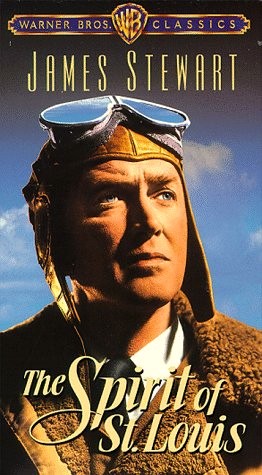
The Spirit of St. Louis (Warner Brothers - 1957)
The Spirit of St. Louis was almost as much of a tour de force on the screen for Stewart as the original flight had been for Lindbergh. Most of the fleeting supporting roles went to actors usually seen as sheriffs in television westerns (among them, Bartlett Robinson as Frank Mahoney, the graduate from Mercersburg). The nearest thing to a woman's role was a two-minute bit by Patricia Smith Lindbergh her pocket mirror for use during the crossing. In what ultimately amounted to Billy Wilder's most striking invention, in fact, Stewart's most important co-star was a fly represented as having gotten into the cockpit shortly before the takeoff from Long Island; it becomes a silent interlocutor for Stewart-Lindbergh musings en route to France.
The few-frills narrative of the picture follows Lindbergh as he persuades a group of businessmen to back him in creating history by flying across the Atlantic, suffers a brief reversal when the owners of the plane he had wanted to fly won't trust him at the controls, and then gets Mahoney and his partner Donald Hall (Arthur Space) to design a craft from scratch. While there is an attempt at some offscreen suspense initially, in having characters report on the progress of other aviators trying to be the first to cross the ocean, this subplot is quickly abandoned in favour of saving most of the screen time of 135 minutes for the actual solo trip and some flashbacks showing Lindbergh's growing passion for his venture. The principal dramatic reversals on the flight are a temporary malfunctioning of a compass and the dangerous forming of ice on the wings. Thirty-three-and-a-half hours after taking off from Long Island's Roosevelt Field, however, Lindbergh completes his trip of 3610 miles, landing at Paris's Le Bourget Field on May 20,1927, where he is greeted by a mob of cheering spectators estimated at the time as having numbered more than 100,000.
And so what?
That, unfortunately, seemed to be the question among American moviegoers, and in no small part because of the Warner Brothers publicity campaign that had been geared from the beginning to salvage what even Hayward and Wilder had come around to seeing could be a commercial fiasco (the picture wasn't released until more than a year after the completion of shooting. When it was released, it was dumped into the middle of the Stewart controversy over his Air Force promotion). With such defensive promotions as conducting a national poll of high school students, asking them to identify Lindbergh and his plane, the message was either that there was going to be a familiar history lesson on the screen for the price of a ticket or that people had once made a big splash about flying a route that had become commonplace—neither a great incentive for opening wallets. The graphics department was even more insipid with such posters as a Stewart looking more retouched than dyed and differently combed above the type legend—IT WAS AN ERA THAT BELONGED TO YOUNG PEOPLE, BUT MOSTLY IT BELONGED TO A SHY LANKY GUY. Writer Wendell Mayes always insisted, for his part, that, familiar or not as teenagers might have been with the name of Lindbergh's plane, they were never going to be attracted to a movie with a title that sounded like an old Judy Garland musical.
The relative few who did go to theaters saw Stewart again at grips with
a biographical subject he was careful not to offend with untoward
emotions. As he had done with Monty Stratton and Glenn Miller, he
channeled most of his insights into technical emulations—not only in
details around the flying, but also in the makeup. As initially odd as
he may look in Lindbergh's blondish red hair, in fact, the actor succeeds
to a surprising extent in covering over the age gap with Lindbergh
to the point that this dies as an issue minutes into the picture
What never quite goes away, on the other hand, is the oddity of Wilder
being the director of such a hagiographic exercise. The usually acerbic
satirist, it turned out, had been as captivated as Stewart by the Lindbergh
feat, from his days as a young Berlin newspaperman, and had aspired to
make the picture for years. His main accomplishment, as he himself
would acknowledge years later, was to blow an original budget of some $2
million into three times that outlay with his insistence on shooting
in as many of the original locations (Long Island, Nova Scotia,
Newfoundland, the Irish Coast, Paris) as possible. Wilder once said:
If The Spirit of St. Louis has a strong point, it is the music score of
Franz Waxman—another ardent admirer of Lindbergh's flight and a flyer
himself. Waxman spent more than two years preparing the score, telling
friends that the subject matter required special treatment.
Stewart's meetings with his boyhood hero ended up being memorable
for the wrong reasons. At a preproduction dinner in which he had
counted on picking up a few tips from Lindbergh, the pair found so little
to say to one another that they ate largely in silence. The actor said afterward:
Another dinner at Chasen's, arranged when Lindbergh called up
unexpectedly from Los Angeles International Airport, ended abruptly.
Stewart:
The only compliment Stewart ever received for his performance from
Lindbergh was for a scene in which the actor tapped on his oil gauge
before taking off. Stewart called the gesture, an ad lib, the "natural thing"
for any pilot to do.
"I missed creating the
character. I felt sorry for Jack Warner. I thought of
offering him his money back, but then I thought he might take it"
"I don't know what
he thought when we got up to leave, but I'll be
damned if I could think of anything to ask."
He was very pleasant. And then we finished the meal, and poor Dave
Chasen came up to him and said, "Mr. Lindbergh, I have a terrible thing
to tell you. And I apologize, believe me. I made a point to have no one say
anything to anyone. . . . But there are forty newspaper people outside.
And they have cameras." And Lindbergh said, "Do you have a back door
out of the kitchen? Would you get me a taxi?" And Dave went back and
he said, "The taxi's there " And Lindbergh said goodbye and walked out
the back. And that's the last time Gloria (Stewart's wife)and I saw him.
Oscars: