
bertolt brecht
(1898-1956)
hangmen also die
threepenny opera
brecht book covers - smartphone page
fatty arbuckle
charlie chaplin
d.w. griffith
jean harlow
howard hawks
katharine hepburn
buster keaton
harold lloyd
groucho marx
george raft
robert ryan
jean simmons
josef von sternberg
andy warhol
orson welles
- bertolt
brecht
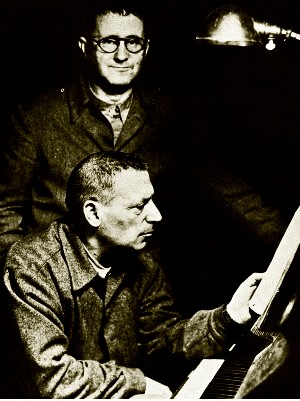
Brecht with Paul Dessau (foreground)
"It is easier to rob by setting up a bank than by holding up a bank clerk."
- Bertolt Brecht
biography
hangmen also die | threepenny opera
bertolt brecht
louise brooks | g.w. pabst | kurt weill
jean simmons | andy warhol | orson welles
art rarities store
Verfremdungseffekt From Brecht to you - Brecht signed books and more @ ebay.com (direct link to signed items) By having his actors step outof character, or by using ironic captions to introduce episodes, he would never allow the audience to forget that they were watching a play and not real life. Through these techniques he hoped that he would provoke hisaudience into thinking more carefully about the events they had seen. In Berlin (1924-33) he worked briefly for the directors Max Reinhardt and Erwin Piscator, but mainly with his own group of associates. With the composer Kurt Weill he wrote the satirical, successful ballad opera Die Dreigroschenoper (1928; The Threepenny Opera) and the opera Aufstieg und Fall der Stadt Mahagonny (1930; Rise and Fall of the Town of Mahoganny). He also wrote what he called "Lehr-stucke" ("exemplary plays")--badly didactic works for performance outside the orthodox theatre--to music by Weill, Hindemith, and Hanns Eisler. In these years he developed his theory of "epic theatre" and an austere form of irregular verse. He also became a Marxist. In 1933 he went into exile--in Scandinavia (1933-41), mainly in Denmark, and then in the United States (1941-47), where he did some film work in Hollywood. In Germany his books were burned and his citizenship was withdrawn. He was cut off from the German theatre; but between 1937 and 1941 he wrote most of his great plays, his major theoretical essays and dialogues, and many of the poems collected as Svendborger Gedichte (1939). The plays of these years became famous in the author's own and other productions: notable among them are Mutter Courage und ihre Kinder (1941; Mother Courage and Her Children), a chronicle play of the Thirty Years' War; Leben des Galilei (1943; The Life of Galileo); Der gute Mensch von Sezuan (1943; The Good Woman of Setzuan), a parable play set in prewar China; Der Aufhaltsame Aufstieg des Arturo Ui (1957; The Resistible Rise of Arturo Ui), a parable play of Hitler's rise to power set in prewar Chicago; Herr Puntila und sein Knecht Matti (1948; Herr Puntila and His Man Matti), a Volksstuck (popular play) about a Finnish farmer who oscillates between churlish sobriety and drunken good humour; and The Caucasian Chalk Circle (first produced in English, 1948; Der kaukasische Kreidekreis, 1949), the story of a struggle for possession of a child between its highborn mother, who deserts it, and the servant girl who looks after it. Brecht left the United States in 1947 after having had to give evidence before the House Un-American Activities Committee. He spent a year in Zurich, working mainly on Antigone-Modell 1948 (adapted from Hulderlin's translation of Sophocles; produced 1948) and on his most important theoretical work, the Kleines Organon fur das Theater (1949; A Little Organum for the Theatre). The essence of his theory of drama, as revealed in this work, is the idea that a truly Marxist drama must avoid the Aristotelian premise that the audience should be made to believe that what they are witnessing is happening here and now. For he saw that if the audience really felt that the emotions of heroes of the past--Oedipus, or Lear, or Hamlet--could equally have been their own reactions, then the Marxist idea that human nature is not constant but a result of changing historical conditions would automatically be invalidated. Brecht therefore argued that the theatre should not seek to make its audience believe in the presence of the characters on the stage--should not make it identify with them, but should rather follow the method of the epic poet's art, which is to make the audience realize that what it sees on the stage is merely an account of past events that it should watch with critical detachment. Hence, the "epic" (narrative, nondramatic) theatre is based on detachment, on the Verfremdungseffekt (alienation effect), achieved through a number of devices that remind the spectator that he is being presented with a demonstration of human behaviour in scientific spirit rather than with an illusion of reality, in short, that the theatre is only a theatre and not the world itself. In 1949 Brecht went to Berlin to help stage Mutter Courage und ihre Kinder (with his wife, Helene Weigel, in the title part) at Reinhardt's old Deutsches Theater in the Soviet sector. This led to formation of the Brechts' own company, the Berliner Ensemble, and to permanent return to Berlin. Henceforward the Ensemble and the staging of his own plays had first claim on Brecht's time. Often suspect in eastern Europe because of his unorthodox aesthetic theories and denigrated or boycotted in the West for his Communist opinions, he yet had a great triumph at the Paris Theatre des Nations in 1955, and in the same year in Moscow he received a Stalin Peace Prize. He died of a heart attack in East Berlin the following year. Brecht was, first, a superior poet, with a command of many styles and moods. As a playwright he was an intensive worker, a restless piecer-together of ideas not always his own (The Threepenny Opera is based on John Gay's Beggar's Opera, and Edward II on Marlowe), a sardonic humorist, and a man of rare musical and visual awareness; but he was often bad at creating living characters or at giving his plays tension and shape. As a producer he liked lightness, clarity, and firmly knotted narrative sequence; a perfectionist, he forced the German theatre, against its nature, to underplay. As a theoretician he made principles out of his preferences--and even out of his faults.
biography
The Marxist playwright Brecht was one of the most important dramatists of the twentieth century, and was a central figure of the early German avant-garde, of which literary Expressionism was a key element. Rather than trying to write realistic plays, Brecht wrote what he termed 'Epic Theatre.' Central to this was his Verfremdungseffekt, or "Defamiliarisation Effect.' 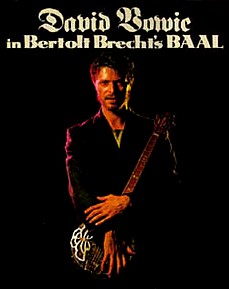
[ d v d s ]
biography
hangmen also die | threepenny opera
bertolt brecht
louise brooks | g.w. pabst | kurt weill
jean simmons | andy warhol | orson welles



Page created by: ihuppert5@aol.com
Changes last made: 2015


