Krautrock
Artist
Krautrock
Content
All the fascinating facts
More
Bitesized
Year
1960s to Present Day
Random and bite-sized facts on all things Krautrock. Totally random but totally fascinating if you're into it. Do you know Krautrock now?
--
Conrad Schnitzler
Conrad Schnitzler co-founded both Tangerine Dream and Kluster (which later became Cluster) — genuine founding pillars of the krautrock scene. He also personally helped a young Düsseldorf band called Kraftwerk get their very first synthesizer, and secured amplifiers for another band's earliest gigs: Ton Steine Scherben. Before his death in 2011, he sent strands of his own hair to friends worldwide, to be buried in locations across the globe. 🎹🇩🇪
--
**NEU! — Conny Plank had almost absurdly little technology.** Michael Rother said that when NEU! made their early records, Plank essentially had a small tape machine and a reverb plate. Yet he could use the tape machine to create delay effects and organise the instruments into the constantly shifting sound of tracks such as “Hallogallo”.
--
NEU! — “Hallogallo” was mixed without computer assistance. Rother said Plank could remember exactly where individual instruments needed to come forward or recede across the ten-minute track. The three men stood around the mixing desk and created the changes manually.
--
NEU! — Klaus Dinger's first take of “Hero” was the one they wanted. During the recording, Dinger tried to improve his vocal, but Rother and Plank immediately felt that the first take had something special. Dinger eventually agreed and they kept the original “flash”.
--
NEU! — Rother says they didn't actually fight about music. Their legendary clashes have become part of the NEU! story, but Rother later said he and Dinger agreed on the music “nearly a hundred percent of the time”. Their disagreements were more about the direction and concept of the project.
--
HARMONIA — they barely sold any records. Michael Rother later described Harmonia as a “total disaster” economically. Their audience took decades to catch up with the music; Rother said the records sold slowly even though they eventually became hugely influential.
--
HARMONIA — “Sehr kosmisch” was deliberately ironic. The title sounds like a perfect example of German “cosmic” music, but Rother said it was actually a joke about the Cosmic movement — one Harmonia did not consider itself part of.
--
TANGERINE DREAM — they played an all-synth concert in 1971. Edgar Froese later said that when Tangerine Dream performed their first concert using synthesizers only, in 1971, nobody had ever seen that kind of stage setup before.
--
FAUST — they deliberately concealed who did what. Jean-Hervé Péron explained that Faust initially avoided revealing individual roles and identities because they wanted people to concentrate on the music rather than the musicians. The mystery surrounding the group was therefore partly intentional.
--
FAUST — the police once mistook their commune for a terrorist hideout. While Faust were living at Wümme, German police arrived believing that a member's girlfriend was Gudrun Ensslin, one of the founders of the Baader-Meinhof Group. She wasn't.
--
FAUST — Tony Conrad came to Wümme and apparently remembered very little. Conrad spent time there recording Outside the Dream Syndicate with Faust. He later recalled the experience as so strange that he claimed the musicians were so stoned that nobody could remember making the record.
--
HARMONIA — the first album used “ping-pong” recording. Rother said they sometimes bounced a mix from one Revox tape machine to another, then added guitar. That very basic setup was used to create Musik von Harmonia.
--
NEU! — Rother says Plank took financial risks for them. To make the first two NEU! albums, the group needed professional studio time in Hamburg. Rother said Plank personally put money on the table alongside them, helping make the recordings possible.
--
NEU! — Rother originally didn't think of himself as a guitarist first. He has described himself primarily as a composer who happened to be most accomplished on guitar. He said he was interested in the whole sound and structure rather than simply being “the guitar player”.
--
TANGERINE DREAM — Edgar Froese rejected the “electronic” label. Despite becoming one of the most important electronic groups in history, Froese argued that electronics were merely tools: for him, music was about what the composer wanted to express, not the technology used to produce it.
**NEU! — “Hallogallo” was made with astonishingly little equipment.** Michael Rother later recalled that Conny Plank had only a tape machine, a reverb plate and some compressors available when they created the sound. Rother said Plank's ability to organise those limited resources was a crucial part of the record.
--
NEU! — even the song titles came afterwards. Michael Rother said the music existed without names for him. Titles were added only after a piece was finished, largely so listeners had something to associate with it. Klaus Dinger and Conny Plank contributed some of NEU!'s titles.
--
HARMONIA — their first audience included Brian Eno. In 1974 Harmonia played to perhaps 50–70 people in Hamburg. Rother later recalled that three men in black were sitting in the front row: one journalist and two others — one of them was Brian Eno, at their first meeting.
--
HARMONIA — some early performances literally put people to sleep. Michael Rother recalled that the band considered themselves a good live team, but joked that at one early concert “the few people who came” actually fell asleep. Their audience response improved considerably afterwards.
--
HARMONIA — “Sehr kosmisch” was a joke. The title sounds like a straightforward piece of cosmic music, but Rother explained that it was actually an ironic comment on the German “Cosmic” movement. Harmonia didn't consider themselves part of that scene.
--
HARMONIA — their first album was recorded in the cold. They worked in the basement of the house at Forst with only one small stove. Rother recalled sitting shoulder-to-shoulder with the others, playing with cold fingers during winter sessions.
--
NEU! — Michael Rother and Klaus Dinger couldn't agree on much. Rother later said their personalities were so different that their conflicts couldn't be separated from the music. He described the fact that they managed to make three albums together as something of a mystery.
--
NEU! — Rother originally went to Forst for a completely different reason. He wasn't planning to form Harmonia. He drove three hours to visit Cluster because he wanted Roedelius and Moebius to help NEU! solve its problem of how to perform live. Instead, he jammed with them and Harmonia emerged.
--
NEU! 2 — desperation created one of its strangest ideas. When NEU! ran out of money during the second album, Rother and Dinger manipulated existing recordings by speeding them up, slowing them down and cutting them apart. Rother later described the experiments as being done out of “sheer desperation” to finish the record.
--
NEU! — Rother says Conny Plank was effectively another member in the studio. Plank didn't write or play the music on NEU!, but Rother said he acted as a “third pole” between himself and Dinger, preventing their arguments from stopping the sessions and helping turn their ideas into finished sounds.
--
CAN — the editing was part of the composition. Holger Czukay and Irmin Schmidt had learned tape editing while working with Stockhausen. With Can, they would create the final form by physically cutting and assembling recordings. Czukay said some Can pieces contained hundreds of tape splices.
--
CAN — Jaki Liebezeit guarded the groove. During Can's painstaking tape edits, drummer Jaki Liebezeit would object if a cut disturbed the rhythm. Irmin Schmidt recalled that even the slightest suspicion that an edit had damaged the groove could bring the process to a halt.
--
FAUST — their studio had enormous homemade effects boxes. At Wümme, engineer Kurt Graupner built Faust giant “Black Boxes” containing fuzz, delay and wah-wah effects. Jean-Hervé Péron said some were about 1.7 metres long — essentially giant homemade effects units.
--
FAUST — they plugged guitars into radios. Jean-Hervé Péron recalled that the group's origins around 1968–69 involved musicians plugging guitars into radios and building their own wah-wahs and fuzz boxes. He later said: “I didn't join Faust – I was Faust.”
--
FAUST — Wümme wasn't just a studio. The band lived and worked inside an old schoolhouse in the countryside. Péron later estimated that they spent about 80% of their time there working on music — sometimes day and night.
--
POPOL VUH — Florian Fricke abandoned the Moog surprisingly quickly. He had become obsessed with his huge Moog, working on it day and night after acquiring it. Yet by 1972 he felt he had exhausted its possibilities and moved towards acoustic instruments and sacred music.
--
POPOL VUH — Fricke's Moog ended up at Tangerine Dream's sessions. His enormous modular Moog was so unusual that Tangerine Dream invited him to bring it to the Zeit sessions. The band initially didn't really know how to use it — they learned by experimenting with the machine during the recording.
--
TANGERINE DREAM — their first Moog was practically scrap. Edgar Froese recalled buying their first Moog from Hansa's Peter Meisel. His description? “A heap of cables and scrap iron.” Nobody seemed to know how to use it properly — but Tangerine Dream bought it anyway.
--
TANGERINE DREAM — Phaedra nearly destroyed their equipment. During the recording, the Moog had to be tuned for hours every day because it had no presets or memory. The tape machine and mixing desk failed, and the speakers were damaged by the extraordinarily low bass frequencies.
--
HARMONIA — sometimes the entire setup was just a Revox. Michael Rother recalled that the first Harmonia album was made with extremely simple equipment. They would sometimes bounce a mix from one Revox tape machine to another, then add guitar. Musik von Harmonia was hardly a high-tech production.
--
CLUSTER — Conny Plank became their “third silent member.” Hans-Joachim Roedelius said Plank taught Cluster how to use the recording studio as an instrument, eventually working with them on records and even touring with them.
--
CLUSTER — they made their own bread. At their rural Forst base, Roedelius and Moebius collected wood for winter, baked their own bread, cooked and gardened, while living among horses, cows, chickens and geese. Roedelius considered this lifestyle part of the music.
--
ASH RA TEMPEL — their first album was deliberately rough. Manuel Göttsching said he wanted the debut to document how Ash Ra Tempel actually sounded live, rather than becoming a polished studio production. One engineer apparently became so frustrated by the band's approach that he walked out.
--
KRAUTROCK — Cluster didn't really consider themselves Krautrock. Hans-Joachim Roedelius later said Cluster never considered themselves part of the Krautrock scene. He felt the label fitted Harmonia somewhat better because of its rock element. Cluster, he said, wasn't really rock at all.
--
Harmonia lived in the middle of nowhere
Michael Rother, Dieter Moebius and Hans-Joachim Roedelius worked together in a farmhouse in Forst, sharing one kitchen and one bathroom. Rother recalled that the only heated room was the kitchen, and they collected wood from the forest for fuel.
--
NEU! couldn't actually play live properly
NEU! were essentially a two-man studio project at first. Rother and Klaus Dinger tried playing concerts as a duo, but Rother had to use a cassette player for backing sounds. Audiences accused them of cheating because
they didn't believe the tape was part of the performance.
--
Harmonia wasn't supposed to happen
Rother originally went to visit Cluster's Moebius and Roedelius because he wanted them to help NEU! perform live. Instead, he ended up forming Harmonia with them. Rother described the first jam as almost “love at first sight” musically.
--
Rother accidentally got a producer credit
This is very obscure. When Rother left Forst temporarily to record NEU! 75, he left his four-track recorder and other equipment behind. Moebius and Roedelius used it to make Cluster's Zuckerzeit and gave Rother a co-producer credit without asking him. Rother later insisted he hadn't actually produced the album.
--
Rother deliberately stopped playing like his heroes
As a young guitarist he copied Harrison, Clapton, Hendrix and Page. In the late 1960s he deliberately abandoned that approach, deciding to “throw away the fast fingers” and see what he could express with a single note. That became a major part of his distinctive guitar style.
--
Harmonia's name was almost an inside joke
The three musicians weren't trying to create some grand “supergroup”. Rother has described the formation as extremely informal, and later explained that Harmonia was partly a joke — despite the enormous reputation the name eventually acquired.
--
NEU! were surprisingly popular in Düsseldorf clubs
Rother recalled that when NEU! came out in 1972, you could go into Düsseldorf's club and discotheque scene and hear “Hallogallo” and “Negativland” playing in several clubs in the same evening. They weren't stars, but the records had clearly penetrated the local scene.
--
Kraftwerk’s famous Kling Klang studio started as an almost empty room in an industrial workshop, not the futuristic laboratory people imagine. Ralf Hütter himself described it that way in a 1981 interview.
--
Florian Schneider’s early electronic experiments began with his flute. Michael Rother recalled Schneider using equalisers, delay machines and fuzzboxes on the flute before synthesizers and computers entered the picture.
--
Kraftwerk commissioned a custom sequencer in 1976 from Matten & Wiechers, a Bonn synthesizer company. That's a great obscure fact because it shows how early they were building technology specifically around their music.
--
The original Kling Klang wasn't just a recording studio — they built instruments there. Early on, they even made their own oscillators and constructed their PA equipment, including plywood bass horns and cast-aluminium midrange horns.
--
The beat on “Autobahn” wasn't simply a conventional drum-machine pattern. Wolfgang Flür modified a rhythm box so he could trigger its individual sounds manually with sticks, giving Kraftwerk a human-played electronic rhythm.
--
David Bowie wasn't allowed into Kling Klang. Even when he visited Düsseldorf and wanted to see the studio, access was refused.
--
Hütter said he composes while cycling. He specifically said he composed Tour de France on his bike and that he doesn't compose on paper — ideas exist in his mind and memory instead.
--
Guru Guru
Guru Guru, led by drummer Mani Neumeier since 1968, once released live chickens into the respectable Grugahalle concert venue in Essen mid-performance. To this day, Neumeier still performs the band's song "Elektrolurch" dressed in a full newt costume. 🐔🦎
--
Guru Guru
In 1996, Mani Neumeier became the first German musician ever to have his own wax figure at Madame Tussauds — in Tokyo, not Germany. Over a career spanning more than five decades, Guru Guru have played over 5,000 live shows and released more than 40 albums. 🕯️🥁
--
Klaus Schulze
Klaus Schulze played drums on the very first albums of both Tangerine Dream (Electronic Meditation, 1970) and Ash Ra Tempel (1971) — two of krautrock's genuine founding records. In 1972, Ash Ra Tempel collaborated with psychedelic icon Timothy Leary, then living in exile in Switzerland, resulting in the album Seven Up. 🥁🇩🇪
--
Florian Schneider quietly left in November 2008 ahead of Kraftwerk's world tour, with only a brief joint statement thanking him for the "40-year partnership," and Ralf Hütter later saying only that Schneider had been "working on other projects" like speech synthesis. Nobody outside the band really knows why, and both men kept it that way for the rest of their lives — Hütter said in 2017 they'd "not really" spoken since Schneider left, and Schneider mostly disappeared from public life until his death from cancer in 2020.
--
Neu!
Neu!'s name wasn't a musical statement — Klaus Dinger deliberately chose it because "Neu!" ("New!") was the strongest word in German advertising at the time, plastered on products everywhere. He even had it professionally lettered by a commercial sign painter. 🇩🇪
--
Neu!
"Hallogallo" isn't a made-up word — it's a playful German portmanteau, blending "hallo" (hello) with "halligalli," slang for wild partying. Recorded mostly at night in a studio with no daylight, Michael Rother later said the darkness pushed them to "create the sun in the studio." 🎸
--
Neu!
Actor and rock star Herbert Grönemeyer — who starred in Das Boot — personally funded the reissue of Neu!'s long out-of-print catalogue in 2001, rescuing it after years of mass bootlegging via his own label, Grönland Records. 🎬
--
Kraftwerk
Kraftwerk's only UK Number One, "The Model," wasn't even meant to be a single — it was originally the B-side. DJs kept flipping the record and playing it instead, forcing EMI to reissue it as the A-side against the band's own wishes. It topped the charts a full three and a half years after it was first written. 🇩🇪
--
Kraftwerk
"The Model" began as a guitar-driven song written by Emil Schult, who was genuinely in love with a model at the time — Ralf Hütter and Karl Bartos reworked it into Kraftwerk's own electronic sound. 💘
--
Kraftwerk
For "Autobahn," Ralf Hütter tried recording real passing traffic by dangling a microphone out of his old grey Volkswagen window on the motorway. The recordings weren't usable — so the band recreated every car sound entirely with synthesizers instead. "Autobahn" reached US #25 in 1975; "Trans-Europe Express" followed onto the Hot 100 two years later, peaking at #67. 🚗
--
Kraftwerk
Kraftwerk were never huge on German charts at the time — early albums barely scraped the Top 30, genuinely niche for years. Decades later they're treated as national icons: the first German band to win a Grammy Lifetime Achievement Award, with one journalist comparing their 2014 Düsseldorf hometown show to "The Beatles in Liverpool." 🏆
--
Kraftwerk
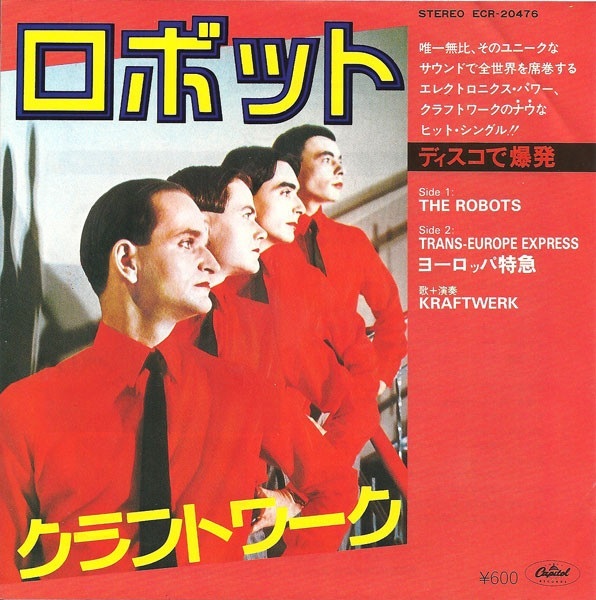
At Kraftwerk shows, robot mannequins of the band — matching suits, sunglasses, mechanical movements — have sometimes replaced the actual musicians on stage entirely, indistinguishable to the crowd. Former member Wolfgang Flür even titled his own memoir I Was a Robot. 🤖
--
Cluster
Cluster made music using alarm clocks, cooking pots, cups, glasses and vases sent through wah-wah pedals and phase-shifters. Asked how they felt about the "krautrock" label, Roedelius replied: "We were never really krautrockers at all." Moebius's response: "But we are Krauts." 🎛️
--
Cluster & Brian Eno
Brian Eno strategically got himself invited on stage at a 1975 Cluster concert in Hamburg. Two years later, they spent three weeks together at Conny Plank's studio — Eno even helped care for Roedelius's baby between sessions. The resulting album sat unreleased for 20 years before finally appearing in 1997. 👶
--
Harmonia
Harmonia — formed by Neu!'s Michael Rother and Cluster's Roedelius and Moebius — sold so little that most people had never heard of them. Yet Brian Eno called them "the world's most important rock band," travelling to their rural studio to record with them in 1976. That album sat unreleased for 21 years. 🎹
--
Can
Holger Czukay left Can in 1977 because his bandmates wanted a "better" bass player — while he wanted to abandon bass entirely for shortwave radio and a homemade sampler built from a modified office dictaphone, later used on his influential solo album Movies. 📻
--
Can
Can's "Yoo Doo Right" was edited down from a single twelve-hour studio improvisation into just under twenty minutes. On the same album, guitarist Michael Karoli revealed singer Damo Suzuki and keyboardist Irmin Schmidt wasted much of their studio time playing chess instead. ♟️
--
Ash Ra Tempel
Ash Ra Tempel's 1971 debut album came with an Allen Ginsberg quote from "Howl" printed inside the sleeve — 45 minutes of interstellar guitar jamming, wrapped in American Beat-generation poetry. 📖
--
Tangerine Dream
Tangerine Dream once performed inside the cathedral where French kings were crowned — 6,000 crammed in, sparking outrage over the "blasphemy." Director William Friedkin was in that crowd and later hired the band to score Sorcerer. In 1980, they became the first Western band allowed behind the Iron Curtain, playing East Berlin. ⛪
--
Manuel Göttsching
E2-E4, now considered a foundation stone of techno, wasn't made for release — Göttsching recorded it in one continuous take purely for his own Walkman on a train journey. Dismissed by German critics as "Muzak," it sat unreleased for three years before Larry Levan championed it at Paradise Garage, reportedly wanting it played at his own funeral. 🚆
--
La Düsseldorf
La Düsseldorf's single "Rheinita" was such a hit that EMI offered the band a one million Deutschmark advance just to break their contract with Teldec. Album sales across the catalogue eventually topped a million copies. 💰
--
Popol Vuh
Director Werner Herzog's soundtracks for ten films, including Aguirre, Wrath of God, came from composer Florian Fricke of Popol Vuh. Their friendship began after a chance meeting in a Munich university library in the 1960s. 🎬
--
Faust
Faust convinced Polydor they were "the German Beatles" and secured roughly £160,000 in today's money, spending it living communally in an old school near Hamburg. German police once showed up, mistakenly convinced a bandmate's girlfriend was a terrorist. 🏫
--
Faust
Faust's third album, sold unedited from their own private tape archive, was priced by Virgin at just 49p. It sold over 60,000 copies and hit UK #12, only to be retroactively disqualified for being priced too cheaply to count. 💷
--
Faust
Faust's 1971 debut was pressed on clear vinyl in a transparent sleeve printed with a real X-ray of a human fist. Two years later, The Faust Tapes' cover was designed by renowned op-art artist Bridget Riley. 🎨
--
Krautrock (the term)
"Krautrock" wasn't coined by the bands themselves — it was a nickname from the British music press, derived from the slur "kraut." Most bands rejected the label, even as Faust recorded their own defiant track literally titled "Krautrock." Decades on, it's worn as a badge of honour. 🇩🇪
Search Keywords
Krautrock
Kraftwerk
Neu!