|
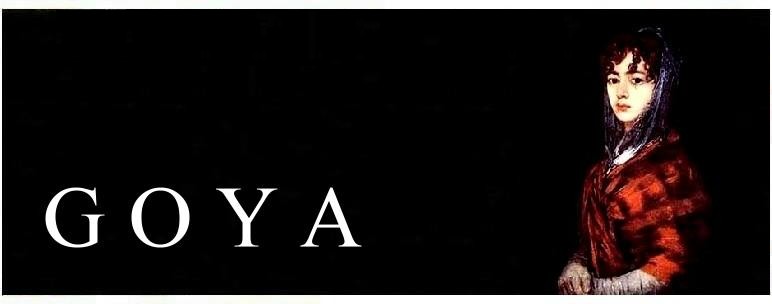
Francisco Goya
Known as: Spanish painter and printmaker
Goya studied in Saragossa until his lovelife and, er, tendency to get involved in the unsociable activities of knifings
made it impossible for him to stay. At 17 he was in Madrid and worked under Bayeu (1734-95), and married his sister...
Recommended Reading:
Goya Hardcover Book by Robert Hughes @ amazon.com
Around 1770 he was in Italy and in Rome in 1771. That same year he returned to Saragossa where he worked in
the Cathedral.
------------
FRANCISCO GOYA: FRAGMENTS FROM A LIFE
(Cont.):
Four years later he was in Madrid and in 1776 began producing tapestry cartoons for the
Royal manufactory. Thus began his successful career and under a decade later he became Deputy Director of the Academy.
By 1799 he was the
Principal Painter to the King though his life was not without suffering. In the early 1790s, he became blighted by ill-health
and became deaf. This suffering had an enormous impact on his work. Periods of introspection juxtaposed with periods of
extreme pain produced a body of dark fantasical work which was at odds with the official portaits he continued to do.
Moreover, Goya could
paint the frescoes of the cupola of S. Antonio de la Florida in Madrid in 1798 while in the same period savagely attack
the abuses of the Church in a series of etchings called Los Caprichos.
Goya wasn't alone in this dichotomy. There were many Spanish liberal intellectuals and artists who reacted in
kind. The dilemma was most acute in 1793 when Charles IV declared war on the new French Republic. The liberals
were sympathetic with the French and when Napoleon's army invaded Spain in 1808 and drove out
Charles IV's successor Ferdinand VII, many Spaniards welcomed his liberalism yet hated
foreign domination. The Duke of Wellington's long Peninsular Campaign drove out the French but during which Spanish
insurgents waged a guerilla war and the French in turn behaved with savagery similar to the Nazis in the 1930s and 40s.
Goya recorded their atrocities in, arguably, the greatest series of etchings ever made,
The Disasters of War (1810-13) and in two paintings now in the Prado, Madrid, 2 May and
3 May 1808 (c. 1814).
When Ferdinand VII was restored in 1814 Goya was pardoned for working for
Joseph Bonaparte, Napoleon's brother who had succeeded Ferdinand VII. Among his work in this period was a portrait of
Wellington. He worked for the Spanish Court until 1824 when there was a fresh wave of
reaction which resulted in him leaving for Paris and then into voluntary exile in Bordeaux.
Trivia:
The series of etchings The Disasters of War were only published in full in 1863, some 35 years after Goya's death
Goya embrached the new art of lithography in 1819 by producing the bull-fighting series The Bulls of Bordeaux
He produced single prints and some etchings and aquatints
His predecessor as Court Painter was Velazquez
He made the Black Paintings at his house near Manzanares, which was known as the House of the Deaf Man
He collected engravings
The best places to see his prints are in the British Museum, London, Madrid (Prado, where else??) and New York (Hispanic Soc.)
BOOK
Affiliate/Advertising policy.
BOOK
Affiliate/Advertising policy.
Leonardo
Goya prints @ amazon.co.uk (direct link to prints)
Affiliate/Advertising policy.
Book Must Read:
|



|
|