DEVO
Links
Buy
Devo Vinyl - direct link @ ebay.co.uk
(Lenin is a participant in the eBay (EPN) affiliate program)
Led Zeppelin Fascinating Facts
Human League Fascinating Facts
Visage / Steve Strange Fascinating Facts
Tears For Fears Fascinating Facts
Queen / Freddie Mercury Fascinating Facts
Danny Thompson Fascinating Facts
Talking Heads Fascinating Facts
Porcupine Tree Fascinating Facts
Adam and the Ants Fascinating Facts
Cabaret Voltaire Fascinating FactsMasami Tsuchiya Fascinating Facts
Kathleen Ferrier Fascinating Facts
Echo & The Bunnymen Fascinating Facts
Queen / Freddie Mercury Fascinating Facts
Marc Bolan and T. Rex Fascinating Facts
Sting & The Police Fascinating Facts
Jean-Michel Jarre Fascinating Facts
Peter Gabriel Fascinating Facts
Holger Czukay Fascinating Facts
Anton Corbijn Fascinating Facts
Dexys Midnight Runners Fascinating Facts
Roxy Music / Bryan Ferry Fascinating Facts
Siouxsie and the Banshees Fascinating Facts
Elvis Presley Fascinating Facts
Scott Walker Fascinating Facts
Michael Brook Fascinating Facts
Penguin Cafe Orchestra Fascinating Facts
David Bowie Rarities (Shipped From UK)
Cocteau Twins Fascinating Facts
Ryuichi Sakamoto Fascinating Facts
Haruomi Hosono Fascinating Facts
Yukihiro Takahashi Fascinating Facts
Hector Zazou Fascinating Facts
Frank Auerbach Fascinating Facts
Devo
Artist
Devo
Content
All the fascinating facts
More
Bitesized
Year
1970s to Present Day
Random and bite-sized facts on all things on the mythical band Devo. Totally random but totally fascinating if you're into it. Do you know Devo now?
--
Devo Began as an Art Project Before Becoming a Recording Band
Devo’s origins lay in an idea about humanity moving backwards rather than forwards. The concept of “de-evolution” developed among art students at Kent State University before the group became known internationally for its music. The events of 4 May 1970, when National Guardsmen killed four students during a campus protest, gave the idea a much darker political meaning for Gerald Casale.
--
Their First Performances Were Closer to Performance Art
Devo’s first performance took place at Kent State’s Creative Arts Festival in April 1973. Their early appearances were deliberately confrontational, combining strange costumes, masks and abrasive, mechanical sounds rather than following the conventions of a normal rock show.
--
Mark Mothersbaugh Initially Wore a Mask Because He Feared Performing
Mothersbaugh was not comfortable being onstage when Devo began performing. According to author David Giffels, the mask he wore in the group’s early days partly came from his fear of performing in front of an audience. What began as a practical disguise became part of Devo’s deliberately unsettling visual language.
--
The Yellow Suits Came from an Industrial Supply Shop
Devo’s early yellow protective suits were not elaborate costumes commissioned from a designer. They were obtained from a janitorial supply company serving the industrial businesses around Akron, Ohio. The utilitarian look fitted the band’s vision of people becoming interchangeable parts in a mechanised society.
--
The Energy Domes Were Inspired by School Light Fixtures
Gerald Casale drew inspiration for Devo’s distinctive stepped headgear from Art Deco light fixtures he remembered seeing at his elementary school in Kent, Ohio. The band called the red hats “energy domes”, giving an everyday architectural shape a suitably strange explanation involving the retention of psychic energy.
--
Their Debut Album Involved a Dispute over How the Music Should Sound
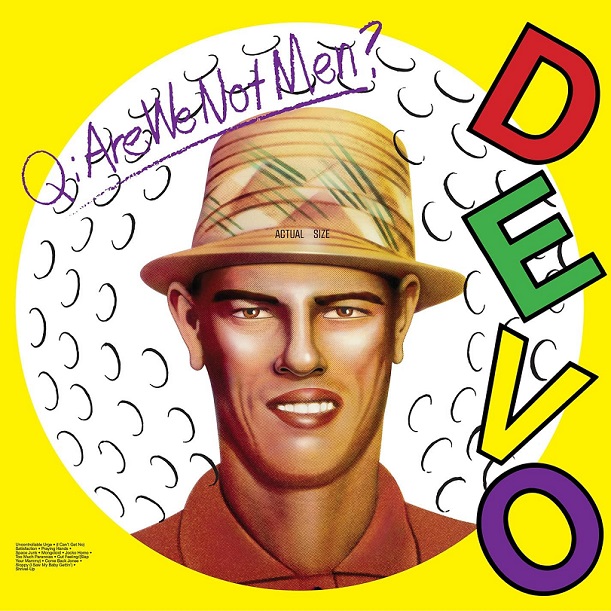
Brian Eno produced Devo’s 1978 debut, Q: Are We Not Men? A: We Are Devo!, but the band resisted changing the sound of songs they had already developed through live performance. Most of the album was recorded at Conny Plank’s studio near Cologne, while “Come Back Jonee” and “Shrivel-Up” were recorded at Different Fur in San Francisco.
--
David Bowie Turned Up During the Debut Album Sessions
Bowie had originally been expected to produce Devo’s first album, but his schedule meant the job went to Eno. Bowie nevertheless appeared at the Cologne studio while Devo were setting up their equipment. The gathering developed into a jam involving Bowie, Eno and members of the German experimental music scene, including Dieter Moebius, Hans-Joachim Roedelius and Holger Czukay. The session was recorded on two-track tape.
--
Their First Film Won an Award Before Their Records Became Famous
Devo’s short film The Truth About De-Evolution, made in 1976, won first prize at the Ann Arbor Film Festival in 1977. The film helped establish the group as a multimedia project, using deliberately strange imagery and performance alongside its musical ideas before their major-label breakthrough.
--
Akron Was Part of Devo’s Artistic Identity
The industrial landscape of Akron was more than the band’s geographical starting point. Factories, industrial supplies and the region’s declining manufacturing atmosphere fed into Devo’s mechanical aesthetic. Author David Giffels has described the city as an almost art-directed backdrop for the group’s ideas.
--
“Whip It” Was Designed to Work on More Than One Level
Gerald Casale has explained that “Whip It” drew on the language of motivational self-help, particularly the idea of pulling yourself up by your bootstraps. Its apparently upbeat message was delivered with Devo’s characteristic irony, leaving listeners to decide how seriously to take the song. That ambiguity was central to the band’s approach: a joke could contain a serious point, and a serious point could be presented as a joke.
--
DEVO
Links
Buy
Devo Japanese Vinyl - direct link @ ebay.co.uk
(Lenin is a participant in the eBay (EPN) affiliate program)
--
He Wrote “Mongoloid” in About 90 Minutes
Gerald Casale recalled writing “Mongoloid” in roughly an hour and a half one afternoon in Akron in 1976, sitting on a couch with his bass. The song’s chilling premise — a man with an intellectual disability who lives an apparently ordinary life — turned a seemingly simple narrative into one of Devo’s most provocative early songs.
--
“Whip It” Was Assembled from Four Separate Musical Ideas
Rather than writing “Whip It” as one complete song, Casale pieced together four different fragments from Mark Mothersbaugh’s demo tapes, recorded with different instruments, tempos and time signatures. Casale found a way to fit them over one beat, and the lyrics he had already written fitted the resulting structure without needing to be rewritten.
--
The Lyrics to “Whip It” Came from Thomas Pynchon
Casale wrote the lyrics after reading Thomas Pynchon’s novel Gravity’s Rainbow. He was particularly amused by Pynchon’s parodies of motivational slogans and Horatio Alger-style tales of success. The song’s apparently cheerful message about overcoming obstacles was his satirical take on American self-help optimism, with a deliberate sexual double meaning as well.
--
“Oh, Pretty Woman” Was Hidden Inside “Whip It”
Casale realised that the guitar riff Mark Mothersbaugh had written for “Whip It” was a warped version of Roy Orbison’s “Oh, Pretty Woman”. Mothersbaugh explained that he had effectively cut the original riff in half and inserted two extra beats. It was a neat example of Devo taking a familiar rock idea apart and rebuilding it into something strange.
--
Devo’s Love of R&B Shaped Freedom of Choice
Casale and Bob Mothersbaugh were enthusiastic fans of R&B, and the band consciously used it as a starting point for Freedom of Choice. Casale played a Moog synthesiser as his bass instrument rather than a conventional bass guitar, while producer Robert Margouleff paid particular attention to the relationship between bass and drums. The result was what Casale jokingly called “funky robot R&B”.
--
“Gates of Steel” Began as a Much Slower Recording
Before “Gates of Steel” became the driving track on Freedom of Choice, Mothersbaugh had recorded an earlier, slower version with Debbie Smith and Sue Schmidt of the Akron band Chi-Pig. Casale later found the tape and loved its chord progression. He brought the music together with lyrics he had written separately, and Devo reshaped it into the more forceful version that appeared on the album.
--
He Played Bass in an Akron Blues Band Before Devo
Before developing Devo’s deliberately unnatural musical language, Casale played bass in the local group 15-60-75, also known as The Numbers Band. Their repertoire drew on blues artists including John Lee Hooker. Casale later explained that he began questioning why he was playing traditional blues while pursuing such confrontational, experimental ideas in his art.
--
He Directed Videos for Bands Outside Devo
Casale also developed a career as a director of music videos and television commercials. His directing work included videos for the Cars, Foo Fighters and Soundgarden, taking his visual sensibility beyond Devo’s own carefully controlled image and performances.
--
He Created a Solo Character Called Jihad Jerry
Casale’s solo project Jihad Jerry & the Evildoers extended Devo’s taste for satire into a character-driven project of its own. The project’s name and deliberately provocative presentation continued his long-running interest in using uncomfortable humour to expose political and cultural absurdities.
He Put Artwork Around Kent State Before Devo Existed
While studying at Kent State University, Mothersbaugh made inexpensive printed artworks and stuck them around the campus. One image featured an astronaut standing on the Moon holding a potato. He later recalled that he was fascinated by printmaking and the freedom to put his own images into public spaces without going through conventional art galleries.
--
He Met Gerald Casale Through an Astronaut and a Potato
Mothersbaugh met Gerald Casale in 1969 when Casale approached him at art school and asked whether he was the person putting up the strange astronaut-and-potato images. The encounter began a creative partnership that would eventually produce Devo’s distinctive combination of music, film and visual art.
--
He Co-Composed Music with Neil Young
Mothersbaugh’s involvement in Neil Young’s 1982 film Human Highway grew out of an earlier theatre project. Actor Dean Stockwell had heard music Mothersbaugh wrote for a one-man show starring Russ Tamblyn and passed it to Young. Mothersbaugh subsequently became a co-composer on the film’s music, an unlikely credit linking Devo with one of rock’s most individual singer-songwriters.
--
He Wrote Music for Pee-wee’s Playhouse at Extraordinary Speed
When Paul Reubens hired Mothersbaugh to score Pee-wee’s Playhouse, the tight production schedule suited him. He recalled receiving material on Monday, writing around a dozen short pieces on Tuesday, recording them on Wednesday and sending them off on Thursday, ready to be mixed into the programme.
--
The Rugrats Music Began a Second Career
Mothersbaugh’s work on Pee-wee’s Playhouse helped establish him as a television composer, eventually leading to the music for Rugrats. The cartoon’s quirky, slightly unsettling sound world was a natural fit for someone whose music with Devo had always treated the familiar as something strange.
--
His Studio Is Also a Collection of Unusual Instruments
Mothersbaugh has collected instruments and sound-making objects that go far beyond conventional guitars and keyboards. His studio has included elaborate devices built from doorbells, organ pipes and bird calls. He has used this kind of experimentation to create sounds that would be difficult to obtain from a standard orchestral or synthesiser setup.
--
He Turned an Old Devo Idea Inside Out for a Film Score
While explaining his scoring process to Pitchfork, Mothersbaugh demonstrated how he reused a musical pattern he had written for Devo around 1975. He said he turned the idea inside out for a later film score, and listeners familiar with the band’s second album, Duty Now for the Future, may recognise a connection with “Timing X”.
--
He Made Music for a Burger King Advertisement
Mothersbaugh’s musical life has included commercial work as well as Devo and film scores. In a 2020 interview, he mentioned a Burger King jingle among the pieces that had shaped his musical history. It fits his long-standing refusal to treat advertising, television and art as entirely separate worlds.
--
He Helped Make Devo 2.0 for Disney
Devo 2.0 reworked the band’s songs as instrumental recordings for a group of young singers selected by Disney. Mothersbaugh recalled that his own children discovered Devo through the project before seeing the original band perform live. Their reaction to the concert was that their father had played “little kid songs” — a family misunderstanding that neatly captured the odd afterlife of Devo’s catalogue.
--
He Was Nearly Eight Before Anyone Tested His Eyes
Mothersbaugh has said that he was born legally blind and that nobody recognised it until he was almost eight. At his first eye test, he could not see the large letter E at the top of the chart. He later connected his unusual visual experience with the way he developed as an artist and musician.
--
DEVO
Links
Buy
Devo Japanese Vinyl - direct link @ ebay.co.uk
(Lenin is a participant in the eBay (EPN) affiliate program)
--
He Wrote “Mongoloid” in About 90 Minutes
Gerald Casale recalled writing “Mongoloid” in roughly an hour and a half one afternoon in Akron in 1976, sitting on a couch with his bass. The song’s chilling premise — a man with an intellectual disability who lives an apparently ordinary life — turned a seemingly simple narrative into one of Devo’s most provocative early songs.
--
“Whip It” Was Assembled from Four Separate Musical Ideas
Rather than writing “Whip It” as one complete song, Casale pieced together four different fragments from Mark Mothersbaugh’s demo tapes, recorded with different instruments, tempos and time signatures. Casale found a way to fit them over one beat, and the lyrics he had already written fitted the resulting structure without needing to be rewritten.
--
The Lyrics to “Whip It” Came from Thomas Pynchon
Casale wrote the lyrics after reading Thomas Pynchon’s novel Gravity’s Rainbow. He was particularly amused by Pynchon’s parodies of motivational slogans and Horatio Alger-style tales of success. The song’s apparently cheerful message about overcoming obstacles was his satirical take on American self-help optimism, with a deliberate sexual double meaning as well.
--
“Oh, Pretty Woman” Was Hidden Inside “Whip It”
Casale realised that the guitar riff Mark Mothersbaugh had written for “Whip It” was a warped version of Roy Orbison’s “Oh, Pretty Woman”. Mothersbaugh explained that he had effectively cut the original riff in half and inserted two extra beats. It was a neat example of Devo taking a familiar rock idea apart and rebuilding it into something strange.
--
Devo’s Love of R&B Shaped Freedom of Choice
Casale and Bob Mothersbaugh were enthusiastic fans of R&B, and the band consciously used it as a starting point for Freedom of Choice. Casale played a Moog synthesiser as his bass instrument rather than a conventional bass guitar, while producer Robert Margouleff paid particular attention to the relationship between bass and drums. The result was what Casale jokingly called “funky robot R&B”.
--
“Gates of Steel” Began as a Much Slower Recording
Before “Gates of Steel” became the driving track on Freedom of Choice, Mothersbaugh had recorded an earlier, slower version with Debbie Smith and Sue Schmidt of the Akron band Chi-Pig. Casale later found the tape and loved its chord progression. He brought the music together with lyrics he had written separately, and Devo reshaped it into the more forceful version that appeared on the album.
--
He Played Bass in an Akron Blues Band Before Devo
Before developing Devo’s deliberately unnatural musical language, Casale played bass in the local group 15-60-75, also known as The Numbers Band. Their repertoire drew on blues artists including John Lee Hooker. Casale later explained that he began questioning why he was playing traditional blues while pursuing such confrontational, experimental ideas in his art.
--
He Directed Videos for Bands Outside Devo
Casale also developed a career as a director of music videos and television commercials. His directing work included videos for the Cars, Foo Fighters and Soundgarden, taking his visual sensibility beyond Devo’s own carefully controlled image and performances.
--
He Created a Solo Character Called Jihad Jerry
Casale’s solo project Jihad Jerry & the Evildoers extended Devo’s taste for satire into a character-driven project of its own. The project’s name and deliberately provocative presentation continued his long-running interest in using uncomfortable humour to expose political and cultural absurdities.
--
DEVO
Links
Buy
Devo Japanese Vinyl - direct link @ ebay.co.uk
(Lenin is a participant in the eBay (EPN) affiliate program)
--
He Bought the Four-Track Recorder That Helped Shape Devo’s Sound
Bob Mothersbaugh bought a TEAC four-track tape recorder that changed how Devo worked on its early songs. With only four channels available, the band had to decide which parts were essential rather than endlessly overdubbing. Mark Mothersbaugh later said this limitation helped make the early recordings stronger, because the arrangements had to work as a complete performance.
--
His Guitar Sound Was Built Around a Solid-State Amplifier
Rather than relying on the traditional valve amplifiers favoured by many rock guitarists, Bob used an Acoustic Model 470 solid-state amp. Its five-band graphic equaliser let him shape the tone into stepped, geometric patterns for different songs. That unusual approach helped give Devo’s guitar parts their sharp, angular sound.
--
A Pawn-Shop Guitar Became Part of His Live Shows
Bob bought a strange-looking La Baye 2x4 guitar from a pawn shop in Akron after spotting it while walking with his girlfriend. He played it onstage for entire shows, despite later describing it as a horrible instrument that was difficult to play and would drop downwards if he let go of its neck. Its unusual shape made it a perfect fit for Devo’s visual style.
--
He Used a Fender Mustang for Two Key Debut-Album Tracks
Just before Devo travelled to Germany to record Q: Are We Not Men? A: We Are Devo!, Bob bought an old Fender Mustang from a pawn shop. He particularly liked its pickup switches, which allowed him to put the pickups out of phase. He used that sound on “Gut Feeling” and “Praying Hands”, helping create their distinctive, biting guitar textures.
--
He Didn’t Set Out to Be a Conventional Guitar Hero
Bob grew up admiring guitarists such as Jimi Hendrix, Eric Clapton and Jeff Beck, but Devo deliberately rejected the arena-rock sound associated with guitar virtuosity. He wanted to make music that was strange rather than impressive in a conventional sense. He has recalled that audiences in Akron sometimes hated the band, threw things at them and even threatened to beat them up.
--
He Helped Make “Whip It” Work in the Studio
For the recording of “Whip It”, producer Bob Margouleff placed the drums in the main room at the Record Plant, while Bob Mothersbaugh’s guitar amplifier was set up in a smaller drum area and covered. The band had already rehearsed the arrangement and recorded it on four-track, so the studio work was about reproducing a sound they knew well and refining it rather than inventing the song from scratch.
--
DEVO
Links
Buy
Devo Japanese Vinyl - direct link @ ebay.co.uk
(Lenin is a participant in the eBay (EPN) affiliate program)
--
He Created the Guitar Figure That Replaced the Stones’ “Satisfaction” Riff
In January 1977, Bob Casale came up with the angular, robotic guitar figure that became the foundation of Devo’s version of “(I Can’t Get No) Satisfaction”. The band were rehearsing in an unheated garage behind a car wash, sometimes wearing winter coats and fingerless gloves. His riff helped turn a familiar rock song into something almost unrecognisable.
--
He Was More Than the Band’s Second Guitarist
Gerald Casale described Bob as a first-rate utility player who moved between rhythm guitar, keyboards and triggering samples onstage. In the studio, he also programmed sounds, recorded instruments and vocals, and helped execute Gerald’s arrangement ideas. His contribution extended well beyond the guitar parts heard on the finished records.
--
He Had a Background in Radiation Technology
Before Devo became his full-time musical world, Bob Casale had trained and worked in radiological technology. Gerald later pointed out that his brother could have pursued a successful career outside music, making his decision to join the group an unlikely detour from a more conventional profession.
--
He Preferred Songwriting to Guitar Heroics
Bob Mothersbaugh recalled that Bob Casale was a great guitarist but didn’t particularly enjoy playing lead, leaving the lead parts largely to him. Casale’s strength was in constructing tightly interlocking rhythm parts and song ideas, with a style that could sound deceptively simple until another guitarist tried to reproduce it precisely.
--
His Guitar Parts Were Still Challenging Decades Later
After Casale’s death in 2014, guitarist Josh Hager took over his role in Devo. Hager has said that learning Casale’s parts made him a tighter player, particularly because of their relentless downstrokes and precise, mechanical feel. What might sound like straightforward rhythm guitar demands considerable control to perform accurately.
--
He Helped Make Devo’s Electronic Sound Work in the Studio
Bob Casale was involved in programming and building the sounds behind Devo’s arrangements, helping translate the band’s ideas into recorded parts. Gerald’s recollections make clear that Bob was one of the people who could take a musical concept and turn it into something practical in the studio, whether through instruments, samples or recording techniques.
--
DEVO
Links
Buy
Devo Japanese Vinyl - direct link @ ebay.co.uk
(Lenin is a participant in the eBay (EPN) affiliate program)
--
He Helped Turn Devo into a Precision Rhythm Machine
Alan Myers joined Devo in 1976, replacing Jim Mothersbaugh. His controlled, exceptionally steady playing helped the band develop the tightly interlocking rhythms that became central to their sound. Gerald Casale later called him a “human metronome”, but Myers could also unleash explosive fills when a song demanded it.
--
The Famous Beat on “Whip It” Started with Another Drummer
The basic drum pattern behind “Whip It” originated with Robert “Bobby” Williams, who had played with Captain Beefheart. Mark Mothersbaugh recorded Williams playing the beat so he could write music over it. Myers then refined the pattern for Devo’s hit recording, adding the precision and accents that made it so distinctive.
--
His Drumming Made “Satisfaction” Sound Almost Alien
Devo’s version of the Rolling Stones’ “(I Can’t Get No) Satisfaction” is a showcase for Myers’s unusual rhythmic control. Rather than reproducing the familiar rock groove, he drives the arrangement with a rigid, disorienting pulse that makes the song sound as if it has been dismantled and rebuilt by a machine.
--
He Could Make a Drum Part Feel Mechanical Without Losing Its Humanity
Devo experimented with sequencers and electronic percussion, but Myers’s playing gave the music a human element that was never quite as rigid as a machine. Mark Mothersbaugh later observed that playing alongside sequencers encouraged the musicians to retain their own warmth and personality while pursuing the band’s trademark precision.
--
He Left as Devo Became Increasingly Electronic
Myers departed during the mid-1980s, after playing on the band’s major albums from Q: Are We Not Men? A: We Are Devo! through Shout. Accounts of his departure point to dissatisfaction with the growing use of drum machines and digital technology, which reduced the need for his live drumming. He had helped define Devo’s mechanical sound, yet increasingly found himself competing with actual machines.
--
He Was a Trained Electrician as Well as a Drummer
Outside his work with Devo, Myers was associated with the practical trade of electrical work. He did not build a high-profile solo career after leaving the band, making his years as Devo’s drummer the period for which he is best remembered.
--
DEVO
Links
Buy
Devo Japanese Vinyl - direct link @ ebay.co.uk
(Lenin is a participant in the eBay (EPN) affiliate program)
--
Jim Mothersbaugh Built One of Devo’s Earliest Electronic Drum Kits
Before electronic drum kits became commercially available, Jim experimented with attaching guitar pickups to the heads of ordinary acoustic drums. He routed the signals through wah-wah pedals, fuzz boxes and an Echoplex, creating a harsh, unpredictable sound that was radically different from conventional rock drumming.
--
His Drum Kit Could Run Out of Control on Stage
Mark Mothersbaugh recalled that Jim’s experimental setup could produce uncontrollable feedback through the Echoplex. Sometimes the sound kept regenerating until Jim had to stop playing and switch the machine off. The technical failures were part of what made the early sound so unusual.
--
He Wanted Drums to Sound Like Weapons
In an interview, Mark explained that he had encouraged Jim to create drum sounds resembling V-2 rockets and mortar blasts. This helps explain why early Devo’s percussion could sound more like industrial noise or military machinery than a conventional drum performance.
--
He Modified More Than Just His Own Instruments
Jim began altering the band’s equipment, including guitars, pedals and synthesizers. Mark recalled that if a keyboard developed an unusual fault that produced an interesting sound, he sometimes asked Jim not to repair it in the conventional way, but to preserve the effect.
--
He Left the Drummer’s Seat but Stayed Involved
Jim’s fascination with electronics eventually overtook his interest in performing. After leaving Devo’s active lineup, he continued helping with equipment, including accompanying the band on tour to keep Mark’s synthesizers working as required.
--
His Work Extended Into the Development of MIDI
Jim later worked for Roland, the musical-instrument manufacturer, and was involved in the development of MIDI technology. His career therefore continued in the electronic-music world that his experiments with Devo had helped him enter.
--
He Helped Make Devo’s Early Sound Less Conventional
Mark has repeatedly credited Jim’s homemade electronics with helping the band move away from a standard guitar, bass and drums sound. The early Devo recordings and films preserve a period when their equipment was often improvised rather than bought ready-made.
--
DEVO
Links
Buy
Devo Japanese Vinyl - direct link @ ebay.co.uk
(Lenin is a participant in the eBay (EPN) affiliate program)
--
Devo Were Paid to Stop Playing
In their early Akron days, Devo often found that local audiences wanted conventional Top 40 cover bands. Mark Mothersbaugh recalled that the group would sometimes be paid to quit after their first set. The hostility helped them develop the confrontational image and distinctive stage presentation that later became their trademark.
--
The Band Recorded an Unreleased Jam with David Bowie and Brian Eno
When Devo travelled to Cologne during the making of their debut album, David Bowie turned up at the studio where Brian Eno was producing them. Mark Mothersbaugh recalled that Bowie, Eno and members of the German experimental music scene joined the band in an improvised session recorded on two-track tape. The recording has been discussed by the band but has remained an unusual piece of Devo history.
--
Brian Eno Added Tibetan Monkey Chants to Their Songs
During the sessions for Q: Are We Not Men? A: We Are Devo!, Eno and Bowie experimented with adding unusual sounds to the band's music, including Tibetan monkey chants. Mark said some of these additions were used, while most were rejected. Gerald Casale later disputed the idea that the sessions were dominated by serious conflict between the band and Eno.
--
Neil Young Told Them Off for Selling Merchandise
Devo appeared in Neil Young's film Human Highway and performed with him. But Mark Mothersbaugh later recalled that Young disapproved of the band selling merchandise, telling them it wasn't cool and wasn't part of rock'n'roll. It was an unlikely disagreement between an established rock star and a band whose visual identity was central to its art.
--
Their Equipment Went Wrong at Knebworth
When Devo played the enormous Knebworth festival in Britain in 1978, the difference between British and American electrical systems caused problems with their effects units. Gerald Casale recalled that the equipment produced horrible warbling noises during the performance. The crowd began throwing objects at the band, and some struck other people in front of the stage instead.
--
They Were Once Offered Johnny Rotten as Their Singer
Virgin Records boss Richard Branson suggested that Johnny Rotten might become Devo's singer. Mark Mothersbaugh recalled that Branson raised the idea while he and Bob Mothersbaugh were in Jamaica in 1978. Mark thought the suggestion was absurd and laughed at it. The proposed combination of the Sex Pistols frontman and Devo never happened.
--
The Band Had a Lounge-Music Alter Ego
Devo sometimes played instrumental, easy-listening arrangements of their own songs before their main performances. Mark Mothersbaugh described these as a way of parodying themselves, although audiences enjoyed them. Warner Bros. declined to release the recordings, so the band issued them independently and, according to Mark, sold thousands of copies.
--
They Wanted to Make an R&B Record with Robots
For Freedom of Choice in 1980, Devo deliberately drew on R&B and Motown, influences that Gerald Casale and Bob Mothersbaugh had loved for years. Casale described the idea as making R&B played by futuristic robots, combining familiar grooves with electronic sounds. The approach helped give the album a more accessible rhythm without abandoning the band's strange worldview.
--
“Whip It” Was Not the Song Their Label Initially Favoured
When Warner Bros. considered material from Freedom of Choice, “Girl U Want” was initially regarded by people around the band as the obvious hit. Gerald Casale recalled that it went nowhere as a single. “Whip It” later became the breakthrough, despite not being the song everyone had first expected to succeed.
--
Devo's Philosophy Was More Important to Them Than “Whip It”
Gerald Casale has repeatedly said that “Whip It” was just one song on Freedom of Choice, not the centre of the band's identity. He and Mark Mothersbaugh were particularly attached to the title track, with its contrast between freedom of choice and freedom from choice. They felt the hit's popularity often caused audiences to overlook the band's wider ideas about conformity and social control.
--
DEVO
Links
Buy
Devo Japanese Vinyl - direct link @ ebay.co.uk
(Lenin is a participant in the eBay (EPN) affiliate program)
--
Devo Sang Backing Vocals on a Debbie Harry Record
In 1981, Mark Mothersbaugh and Gerald Casale sang backing vocals on Debbie Harry’s solo track “Jump Jump”. They used the pseudonyms Spud Devo and Pud Devo. The session took place while Harry was recording at New York’s Power Station, with Nile Rodgers producing her album.
--
The Band’s First Two Albums Drew on Years of Unreleased Songs
Gerald Casale explained that the material for Q: Are We Not Men? A: We Are Devo! and Duty Now for the Future had largely been drawn from a stockpile of around 50 or 60 songs written between 1974 and 1977. By the time they made Freedom of Choice, the band deliberately abandoned that backlog and wrote a fresh set of songs in Los Angeles.
--
Bob Mothersbaugh and Gerald Casale Wrote Songs Without Mark
Casale revealed that he and guitarist Bob Mothersbaugh often worked together in Akron when Mark Mothersbaugh wasn’t around. They shared a house and rehearsed there during 1974 and 1975, developing material that rarely made it onto records. Their later collaboration on “Cold War” for Freedom of Choice was part of a longer songwriting relationship.
--
Their First Synthesizer Appearance Predated Their Record Deal by Years
Gerald Casale recalled that Mark Mothersbaugh played a Minimoog at Devo’s first performance as a proto-band at Kent State University in 1973. Synthesizers were therefore part of their musical thinking from the outset, rather than an addition made after they signed to a major label.
--
They Initially Wanted to Be an Art Movement
Mark Mothersbaugh has said that Devo began with ambitions beyond being a successful rock band. The members wanted to create an art movement, using music, film, performance and visual design together. Their matching uniforms, distinctive symbols and deliberately artificial stage personas were integral to that idea, not simply a marketing gimmick added later.
--
The Band’s Name Came from an Idea of Human Regression
“Devo” came from “de-evolution”, the theory that humanity was not necessarily progressing but could be moving backwards. Gerald Casale and Mark Mothersbaugh developed the idea while studying art in Ohio. The concept became more urgent for Casale after the Kent State shootings in May 1970, which killed four students, including two of his friends.
--
They Were Already Using Synthesizers Before Punk Became Mainstream
Devo’s early performances combined synthesizers with abrasive guitar and deliberately awkward rhythms at a time when their sound was difficult to place within conventional rock categories. Casale recalled that the Minimoog was present at their 1973 performance, several years before their debut album appeared in 1978. Their electronic identity was not simply a reaction to the new-wave boom.
--
Search Keywords
Devo
Whip It
Icons
DEVO
Links
Buy
Devo Vinyl - direct link @ ebay.co.uk
(Lenin is a participant in the eBay (EPN) affiliate program)
Led Zeppelin Fascinating Facts
Human League Fascinating Facts
Cabaret Voltaire Fascinating Facts
Visage / Steve Strange Fascinating Facts
Tears For Fears Fascinating Facts
Siouxsie and the Banshees Fascinating Facts
Queen / Freddie Mercury Fascinating Facts
Danny Thompson Fascinating Facts
Talking Heads Fascinating Facts
Kathleen Ferrier Fascinating Facts
Echo & The Bunnymen Fascinating Facts
Porcupine Tree Fascinating Facts
Adam and the Ants Fascinating Facts
Kula Shaker Fascinating FactsVisage / Steve Strange Fascinating Facts
Tears For Fears Fascinating Facts
Queen / Freddie Mercury Fascinating Facts
Masami Tsuchiya Fascinating Facts
Marc Bolan and T. Rex Fascinating Facts
Sting & The Police Fascinating Facts
Jean-Michel Jarre Fascinating Facts
Peter Gabriel Fascinating Facts
Holger Czukay Fascinating Facts
Anton Corbijn Fascinating Facts
Dexys Midnight Runners Fascinating Facts
Roxy Music / Bryan Ferry Fascinating Facts
Elvis Presley Fascinating Facts
Scott Walker Fascinating Facts
Michael Brook Fascinating Facts
Penguin Cafe Orchestra Fascinating Facts
David Bowie Rarities (Shipped From UK)
Cocteau Twins Fascinating Facts
Roxy Music / Bryan Ferry Fascinating Facts
Ryuichi Sakamoto Fascinating Facts
Haruomi Hosono Fascinating Facts
Yukihiro Takahashi Fascinating Facts
Hector Zazou Fascinating Facts
Frank Auerbach Fascinating Facts